Sunday, March 6, 2011

Oil Price Increases Result of Terrorism in New York, not Middle East


Lately the fallacy has been spread that Libyan unrest combined with Egyptian and Tunisian uprisings have caused oil prices to spike up to over $104 per barrel as of the close of business on Friday March 4. Proponents of this theory declare that real concern exists that Saudi Arabia is also susceptible to such unrest leading to severe supply shortages in the future.

That said, there have been no substantial supply disruptions. In addition, US oil inventories remain at record levels. Further, OPEC has pledged that it will continue to meet its supply target regardless of disruptions in Libya, as Libya only represents less than two percent of the world's oil. Finally, Saudi Arabia has shown no sign of instabillity except for its proximity to the unrest, even though Southern Europe is far closer to Libya than the Middle East.

Since the last collapse in the price of oil in 2008, numerous OPEC leaders have said that $70/barrel is the requisite price for speculative oil exploration to remain profitable outside of the Middle East. This $70/barrel represents an apex in prices, where non producers find it profitable to become producers. Think of it as the wage necessary to make an engineer change professions to a carpenter. $70/barrel equals cost to remove + reasonable profit + premium to change behavior in a country that has made a decision oil drilling is not in their best interest economically.

So why are we at $104/barrel? Long positions by hedge funds and speculators has increased thirty percent since March 1, 2011. These individuals are unilaterally buying up oil contracts with the cover that the media will present the Middle East uprisings as dire. What is undesirable about these individuals behavior is that they are not end users of oil, such as refiners or power companies, they are merely adding as much money on margin as possible to exacerbate the oil increase. Why do they want to buy oil, simply to sell it to those end users at the end of the month's contract at a premium. Since the NYMEX crude oil market is relatively small in market cap compared to the NYSE or NASDAQ, relatively small amounts of money can create price changes. Also the availability of purchases on margin with little down payment reqyirements make the NYMEX an attractive place for market manipulators who desire to disrupt the purchase and sale transactions of drillers and end users.

The paramount issue is not supply, not producing countries and not the market.... it's simply American traders who want the price to move up at the expense of the entire country for their individual greed.

Three weeks ago, the market saw oil lose 3 percent in just under three hours when the CFTC and ICE raised speculators margin requirements 12 percent to purchase oil. This meant speculators had to put 6% down instead of the 5% that was previously mandated. Six Percent?????!!!!!!! Well, perhaps the inability of regulators to demand a reasonable hard money commitment is the issue in and of itself.

Aside from the common sense solutions of disallowing all participants except for end users to access auctions or the elimination of auctions all together, an effort to end price manipulation in oil markets should also include a commitment of over $6,300 to purchase $100,000 of oil contracts.

Wednesday, January 26, 2011

The Currency Seesaw


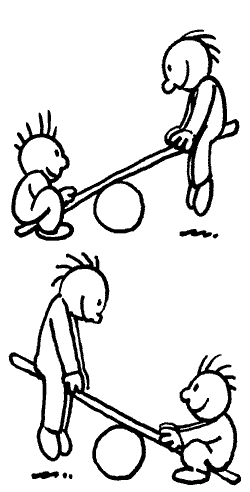
Picture two children on a Seesaw. One child elevated in the air feverishly jumping on his seat in an attempt to push himself back towards the ground. The other child sternly seated on his seat with his feet anchored under steal stirrups in the sand refusing to allow his seat to move up towards the sky. Can you picture it? Could you picture the balance difficulties of the child in the air as he pounces on his seat to push it down? Can you imagine the bruising of the crotch being experienced by the child who is attempting to anchor himself down? If you can, you now understand precisely the relationship of the US Fed vs. emerging markets' central banks.

If you ever wondered why the Federal Reserve Policies are failing to create the desired inflation in the United States, the answer would clearly be the trade deficit. If you then wondered why the rest of the world is struggling with food and commodity inflation, the answer would clearly be their resistance to currency appreciation.

Of course it is no secret that every country is better off as a net exporter. Collecting money instead of paying it is always the path to greater wealth. That said, the great equalizer is currency appreciation. Currency appreciation is the only way that the two children peaceably stay in balance on the seesaw. As one country purchases, or imports goods, from another it must purchase the exporting country's currency (a capital inflow) to complete the transaction. When this purchase occurs on a frequent basis the exporting country experiences currency appreciation which reduces the cost advantage it has in producing exports. With that appreciation, the population of the exporting country realizes greater purchasing power and higher standards of living for its population. The exporting country over time becomes better able to import at a more affordable rate and becomes progressively more stable as an economy due to purchasing power. Thus, the seesaw is able to balance the children according to their actual weight or on each country's production on the merits of the goods, rather than just input costs.

However, what does a net exporter do if they wish to protect their status as an "Exporter?" Well, you surely figured this one out. They manipulate their currency by making capital inflows less attractive and/or interfering in the currency exchanges. Sound familiar? Japan selling Yen for US Dollars, Brazil placing exorbitant taxes on capital inflows, China exchanging Yuan for US Dollars in a closed government controlled non-market based exchange and India raising interest rates (In India's case this certainly isn't going to work in battling currency inflation is it? But that is a topic for a different article. Higher interest rates=greater rates of return for foreign currencies).
What is the fallout of a country purposely holding its currency down? Items that are valued in US Dollars such as food, fuel and steel etc. get rather expensive for its population as they are being paid for their production in the currency that is being devalued by their government. Unable to provide comfortably for basic needs such populations may resort to civil unrest or similar types of behavior. Sound familiar?

The net result is exporters that refuse to accept currency appreciation disallow the seesaw to find balance. The country in the air (the US) will stay in the air unable to create substantial jobs due to its HIGH currency valuation and inability to compete with lower employment costs. Its population will be reduced to balancing deficits, both fiscal and trade, while confined to its space on the surface area of the seat well above the ground. Unable to expand, the US may attempt to print its currency at an alarming rate- effectively jumping up and down on that seat to become more competitive and create growth. Emerging markets may insist on anchoring into the stirrups on the ground and edure the great discomfort from the seat punding against their unmentionables to maintain their position. In such a scenario the worst of results occurs if one of the parties breaks the others resistance sending one into the tree and the other face down into the dirt.

So, the next time the US Treasury Secretary states that China, "Must allow its currency to appreciate to create balance," think of him saying, "Let us down you creeps." Conversely, when you hear China respond with "It is in both of our interests for our currency to appreciate but it must be gradual,"- remember it is better to take it groin than to be hopelessly stuck in the tree.

Wednesday, December 29, 2010

The 99 Week Dilemma


With the recent passage by the United States Congress to extend the availability of 99 weeks of unemployment insurance for an additional 18 months a unique question arises, "Does longer term unemployment benefits affect migration flows?"

From a humanitarian aspect I am a supporter of unemployment insurance. For intervals of somewhere between ninety days and six months, unemployment insurance is an important facet of civilized society. Unemployment insurance reduces the inflammation of societal unrest and generally provides a much needed safety net for not only the unemployed individual and his or her direct creditors, but his or her community as well. That said, is long term unemployment insurance creating distortions in the labor market?

Here is the rub: Joe loses his job in California where he lives with his family. His children are in school, his mother works in town and all his brothers and sisters are nearby. It is a perfect situation, well at least until the factory closed last week. Now, Joe really needs, and in fact wants, to get back to work. The problem is that the town has been hard hit and jobs like his just aren't available. What does Joe do?

Well, assuming unemployment benefits are a "necessary" safety net, meaning Joe doesn't have adequate savings to wait for employment, Joe would certainly be forced to move if no benefits were available. As a national average, despite recent trends indicating the savings rate of Americans is on the rise (over 7% at last reporting), Americans are ninety days from being broke. This means that if our Joe is in fact an "average Joe," he has ninety days to replace his paycheck or face a dire circumstance.

With the extension of unemployment benefits, workers are given a longer period to replace employment. With ninety-nine weeks of benefits and ninety days of savings, the unemployed are given the option to "wait and see." The drastic, life altering, option of uprooting oneself and leaving family behind, becomes a more distant last resort. While quite understandable, is this behavior causing market distortions in the National labor market?

Currently the Midwest, meaning Nebraska, Iowa, South Dakota, North Dakota, Kansas, Oklahoma all have unemployment ranges far below the National Average. That said, California, Nevada, Arizona, Florida are well above the National Average. Also, these relative levels have remained since the first of signs of the Great Recession in 2008 three years prior. With the current era's speed of travel and the ability of job seekers to connect with prospective employers in an instant through the Internet, why is it taking so long for people to move to more favorable job markets?

Desirability ? Inability to sell one's house? Familial roots? Perceived standard of living? Regardless of the validity of one or all of these reasons- all of them are luxuries. Starvation, homelessness and inability to provide the basic necessities certainly would trump them. During the Reconstruction Era Depression or the Dust Bowl Americans migrated far and wide to search out opportunities for work. Even in more recent recessions such as the energy crisis of the 1970's, I had the personal experience of watching my father move away to find work leaving my working mother behind to care for me while he settled into a more prosperous region. Labor moved to meet capital. The rebuilding process inert in capitalism's cycle of life thus began again.

While I am not selling one that capitalism is the paramount economic system, nor am I suggesting that providing those without isn't noble- I am merely asking whether in a capitalistic system prolonged benefits are distorting the natural reallocation of labor and capital? If the answer is yes, the more important question is: Whether the prolonged benefits will in fact work in putting Americans to work in their hometowns or whether in the end the invisible hand will force these individuals to move regardless?

Wednesday, November 3, 2010

Exchange Rate Roulette


The world is engaged in a game of "tug of war" that is as unprecedented as it is unpredictable. In the past, the quest to be a net exporter was often managed by import taxes, supply restraints and trade agreements. In the new world of "free" trade countries now are using indirect means to achieve the desirable end of being the world's supplier.

While this concept of currency manipulation is not new, the United States attempts to answer through quantitative easing is in fact new. The real question is what took so long for the United States to answer? Leverage certainly masked the problem for quite some time as corporations created multinational identities with no allegiance to any given population. As Americans saw their wages flat lining due to deflationary wage pressures from overseas and technology advances, Profits soared due to the lower input costs. These profits unfortunately were unsustainable because the American worker no longer fashioned the same sense of purchasing power.

In other words, instead of paying the cost to build it at home so we could afford to consume it, corporations built their goods elsewhere. Through a favorable credit corporations could enjoy these maximized profits by selling their goods to the debased American workforce over time. The problem of course is that one can only lend to a certain threshold and still expect repayment. The second problem is that because of the insufficiency of wages paid to workers in foreign manufacturing countries those workers were not viable as consumers for the goods produced.

Since wealth is not created by income, but rather sustainability of one's standard of living- the American practice of being a net importer was doomed to fail. This failure was systematic and without reprieve. Eventually lending had to slow due to ability of the borrowers to pay. Without lending deflation was almost certain. So it is certain the American worker in mass must produce as much or more than they consume to create sustainability. Americans cannot continue to consume and not produce, because production creates the wages with which they are able to consume. Conversely, wealth is assured if the Americans can produce more than they consume because that surplus is savings. Of course this is the benefit of being a net exporter.

That said, with countries such as Brazil and North Korea limiting and taxing capital inflows that would cause their currencies to naturally appreciate, how does this game end? With Japan and China dedicated to purchasing US dollars to diffuse currency appreciation and undermine the Fed's efforts to devalue the currency, is the end a net wash? Perhaps its a game of chicken that dares the other to veer off of collision course first. If we keep printing money simply for them to buy it up to maintain status quo can capital flows ever reach equilibrium?

In sum, the end game will have to be accomplished through direct means such as treaty or taxes since no one seems to be willing to say "uncle." Of equal importance America will have to deregulate the workplace requirements and union strongholds on issues of workplace standards if America is to compete for the world's jobs in the future.

Saturday, October 2, 2010

The Mirror and the Window


"ANYONE CONTINUALLY KNITTING HIS LIFE INTO CONTEXTS OF INTENTION,IMPORT AND CLARIFICATIONS OF MEANING WILL IN THE END FIND THAT HE HAS LOST THE SENSE OF EXPERIENCING LIFE,"
- JOSEPH CAMPBELL

A Carney, of sorts, travels the continent with his magical house of mirrors. His mirrors are magical because they represent all the ways in which man could judge him or herself. Each mirror- a standard for which purpose is usually derived.

There is a mirror of Morality, Society, Capability, Purpose, Strength and many more. The traveling man sets the mirrors along the edges of the room surrounding an empty center. Standing alone in the middle of the room is a four sided mirror that reflects Success.

Visitors are encouraged to look in each mirror individually and then use each mirror to angle its reflection into the Success mirror so that both reflections are revealed in one frame of vision. At the end of a trip through the perimeter mirrors, guests are directed to walk slowly around the four sided mirror of success in the center of the room and "re-read" the reflection of the numerous perimeter mirrors in the reflection of the the Success mirror.

Some hover in the Success mirror with it reflected against Morality. Others read the reflection of Success against the mirror of Capability. As people vary in taste, they also tend to value the amount of time spent in each mirror differently.

Some cry when they view the mirrors, some cheer, some are awestruck and some get angry at what they see. The Carney does his best to be a good host to his guests and always offers to adjust the lighting and change the angles of the mirrors to best suit his customers' preferences. Should a woman feel wronged by the Societal mirror, for instance, years of experience allow the Carney to adjust the lights and add props, such as clothing and lenses, to satisfy her. As a disclaimer to those who may be offended by the mirrors the Carney proclaims, "My mirrors are not calibrated for every height and proportion so please ask for assistance should the mirrors not accurately reflect the requisite standard to your satisfaction and I will be happy to make the necessary adjustments."

Over the years, the Carney is engulfed with observing his guests encounter the mirrors. He rarely takes a break from his work. The Carney actually rarely even goes into the outdoors. Rather, he keeps a detailed journal of all of that happens and every unbelievable encounter that occurs in his house of mirrors. There aren't many days that the Carney doesn't feel like the luckiest person in the world for being the possessor of such important and fulfilling items.

Queens, socialites, Wall Street billionaires, mystics, artists, musicians and clergy come and go. The responses of these people seldom disappoint the ever watching Carney. In fact, as time passes there are two fairly predictable occurrences: 1. When in the house of mirrors people tend to distance themselves from other guests, whether acquainted, related, in love, best friends or strangers, and 2. People spend disproportionate amounts of time at each mirror. That said, a line always forms at the coup De teat- the Success mirror.

One day a very simple and normal looking man pays his admittance and enters the mirrors. The simple and normal man acts peculiarly once inside the the room. He first weeps and then proceeds to scream. The Carney finds this simple and normal man's behavior to be extremely odd as the man had yet to even reach the first mirror. The simple and normal man walked towards the participants and began to plead with them. He proclaimed:
"Leave this place. It is not you in and of yourself, by yourself and thinking of yourself, that determines your relevance."
The customers began to work their way away from the simple and normal man attempting to create space from him and still find the answers they sought with their admission ticket. The simple and normal man continued his mission by walking in front of many of the guests and blocking the mirrors. He said:

"Your worth, your answers, your self, is not found this way. It is not the reflection of light that is reality, it is the light itself."

Having disturbed the client base substantially, the Carney came out of his perch high in the rafters and demanded the simple and normal man to leave. After restoring order, the guests once again began to gaze and pose, smile and frown, turn and shift in the mirrors as they always had. The magic of the mirrors was restored and all was calm as the Carney liked it.

After that strange day many more years passed in the manner they had always passed in the Carney's world. The Carney had grown quite wealthy through providing his service of magic mirrors. Then one night at closing time the simple and normal man from many years ago appeared at the door. The Carney greeted him cordially but cautiosly by saying, "I want no trouble please let us be."

The simple and normal man looked deep into the Carney's eyes, something the Carney hadn't experienced since he was a child, and gently said:

"Walk with me through the mirrors. You and I will come to an understanding."

The two entered the room as the simple and normal man took the Carney's hand. He looked at the Carney as they walked the perimeter in a forced, but even, pace. As they walked, the Carney's eyes filled with tears. His skin prickled with anxiety and sweat began to surface on his back and coat his skin beneath his clothes. The Carney felt the tears come on even stronger and his throat close down as the simple and normal man made no reflection in any mirror. The two reached the Success mirror, one in blithering tatters comprised of red wet eyes and shuttering- the other calm and compassionately resolved to finish the gauntlet. The Success mirror bore no reflection of the two men, one supporting the other as a soldier carries the wounded to safety on the battlefield, the mirror only reflected the lights of the room. With this the simple and normal man, while staring forward into the mirror bearing no image and essentially holding the Carney up, said:

"Our Journey is to comprehend and find happiness in the light, not it's reproduction."

Crying and chilled to the bone the Carny finally broke the simple man's grasp and fell to his knees. The simple and normal man knelt directly in front of him and stared into the top of the Carney's bowed head as if speaking into his soul directly and whispered:

"One must let go of self to find bliss. In the world it is impossible to truly see one's self if it is isolated from its place.... the web that connects all."

The simple and normal man then left the room never to return and the Carney followed him into the wilderness.

Monday, June 21, 2010

Why the US struggles with a Budget


Americans in general seem to be concerned about the Federal Budget Deficit and the level of the National debt. While valid, do these same Americans know how to create a surplus? Is this simply partisanship and saber rattling or are they serious? As an independent voice in the era of politically owned media- this blog will explain the necessities to create a budget surplus and then reduce the National Debt. Be warned, budget discussions are always uncomfortable and often take sacrifices. Since I am not a partisan- this discussion is sure to upset all who are.

Let us start with the latter, reducing the National Debt. This is simple, once we have a budget surplus we must dedicate no less than 50% of that surplus to paying down our debt. So how do we create a budget surplus?

1. National Defense. The most expensive portion of our expenditures is National Defense. From a budget perspective it was pure insanity to enact the tax cuts of 2000 and then start a war in 2001. Even dumber was the choice to start two. Even worse is our continued choice to fight them both.
Since the beginning of time, war constituted assessments on that country's citizens to pay for them. War is extremely expensive and not an attractive behavior for fiscal responsibility. War bonds have been floated, taxes raised, and rationing instituted in the past to help bear the costs of going to war. None of these measures have been instituted in these two current wars that have lasted twice as long as World War II.

Solution: End the wars immediately, we can't afford them. This may cause future danger to some Americans, but safety is never a guarantee. There will always be violence, always. The point is to minimize it in a cost effective manner. In addition, TSA, defense spending, military spending, CIA, FBI, DEA and all other public safety must be cut. Seventy percent of the US Government's budget goes to the military and public safety. Cuts in this arena is the fastest track to fiscal discipline. The balancing act is not what does it take to keep every American safe, but what can we afford to spend to keep the most amount of Americans safe.

Second, to help fill the hole created in our budget, the United States must ensure payment of reparations from the defeated countries of Afghanistan and Iraq. Should currency be insufficient, natural resources that can be easily exchanged for currency would suffice. This second part is very difficult to enforce because the United States was the aggressor in both wars and thereby not truly eligible for reparations. That said, the victor in war has traditionally had reparations paid in exchange for relinquishment of control and/or peace.

Social Security and Medicare. The second largest portion of the Government's budget is Social Security and Medicare. This is the time old political trap because folks eligible for Social Security and Medicare tend to vote at a higher percentage than those not receiving these subsidies. That said, cutting defense spending is not exactly politically popular either. Remember the point of this article is not the political double speak one finds in the Republican and Democratic controlled news stations- this is the straight stuff.

Solution: Social Security and Medicare must be made smaller. Privatization does not work, because whenever the market gets involved the trademarks of markets, greed and fear, take hold. Those trademarks create volatility not suitable for people of age. Since we live longer, the programs need to reflect our ability as a people to work for more years. Remember the intent of these programs is to provide for those who CANNOT provide for themselves. Social Security was never created to be a retirement program. Clearly, there is an age when we as citizens no longer can gainfully be employed, but at the current age limits we see seniors engaged in massive fraud to make sure they qualify for these social programs when it is not yet necessary. Manipulating income and assets is rampant in the United States to ensure qualification. In fact, many financial planners encourage and assist in such crimes. Simple fix, increase the age by ten years retroactively. Remember, this is not about being fair or proper, this is serious budget talk.

Unemployment, AFDC, and Disability. These programs need to be budgeted per the revenue of the Country as a whole and pegged to that revenue as a fixed percentage. Businesses may plan for the future, 5, 10, 20, 50 years, but they do not budget by the year because they cannot forecast sales that far in advance. Businesses budget by the hour by fixing expenses to a percentage of sales. The government must adopt this practice when it comes to entitlement spending.

Solution. Entitlement spending must be tied to revenue in the given quarter. Currently these programs encompass approximately 18 percent of the Federal Budget. So, the Government must ensure that these programs never exceed there intended level of impact. In other words, if the Government chooses entitlement spending is appropriate for 15% of the total budget, then benefits shall be reduced pro rata by any declines in Federal tax receipts and also increased by the same measure. This is simple budgeting. If the Federal Receipts are trending lower by 3 percent per the oodles of payroll and earnings reports generated on a weekly basis, then benefits shall be three percent less in that quarter (notice the cut comes in the current quarter when a businessman budgets, because the preceding quarter is irrelevant and the future is never certain). If those reports show an increase of 6%, then everyone receiving aid gets a raise.

One more important thing about this system is that it is mathematical and cannot quantitatively be abused. If too many people are using the benefits, payouts will be too low because the receipts generated by taxes will be lower and benefits will not create enough money to live well. Subsequently, those that can work and do better will. Once the marginal recipients return to work, those who truly cannot work will get a raise because of increased revenue in the system. From a budget standpoint the equilibrium of entitlements (where people will enter and leave the entitlement programs based on individual payout amounts) described in the preceding sentence doesn't matter because the payments shall never exceed the designated percentage.

Natural Disasters. Simply stated, we cannot budget for something that would happen by surprise. As a result, localities must be responsible for their own natural disasters. Volunteerism, charity and local authorities must right these occurrences.

Environmental Agencies. Simply stated, Environmental Agencies such as the EPA must be self funding without any dedication of tax payer monies.

TARP, FDIC and Redevelopment. The government should always take chances such as these when available as a lender or contractor of last resort because they are necessary to ensure tax receipts for the future and are generally revenue positive. TARP, for example, was a massive success of the Bush Administration. Currently with many loans yet paid back the program is already ahead in sum without those repayments. Should the outstanding debts be paid back without default, the program will yield over a 14% per annum return on investment. That's revenue positive and budget friendly.


Solution: When feasible, and sufficient collateral or equity available, the Government should act in its best interest fiscally. No business could budget itself with flat lining or declining revenue streams. As a staunch believer that raising taxes beyond its optimum level actually reduces revenue, the Government should always tax at its maximum level of efficiency (which is most likely lower than current levels). To supplement income, the Government should make business ventures that provide adequate return on investment. After all, there is little risk since the Government is immune to bankruptcy laws making its investments always collectible.


So after this brief common sense budgeting exercise are you truly concerned about the budget? I can assure you that many cannot honestly answer yes. Most say yes to some of these basic budget principles, but no to others. Many only want to budget when it is convenient. Tea Party constituents are generally not willing to cut defense, even though its the biggest and most over spent portion of our budget. Many others want to end the war, but won't stand for poverty. If one truly claims to be pro balanced budget or budget surplus, there can be no emotion and no gray area. After all, its all just simple addition and subtraction with a few fractions. The numbers are neither good nor evil, they are just numbers. Right?



Tuesday, May 4, 2010

The Truth about Inflation


My senior year thesis in Economics was Brazilian hyperinflation. After creating oodles of econometric models based on numerous commonly held truths about inflation, the only factor that was significantly correlated to hyperinflation was inflation expectations.


The news, the financial analysts and even the Wall Streeters love to talk about inflation and its roots being firmly grounded in money supply. The truth is that while money supply is a factor, the issue of inflation is psychological. A government can theoretically print money until kingdom come, so long as the population values those dollars the same.


This reality of people not realizing increased money supply as inflationary is often explained by financial spinsters as the theory of the velocity of money. In other words, whether money is actually being circulated or whether it is parked in places where it isn't creating new capital or purchasing goods and services. In other words, under this theory the printing money without that money being used is a canceling of sorts of inflation.

While I believe from a strict construction stand-point these two theories may amply define the causes of inflation- the real question still comes down to people's perception of money's value. With record deficits and the printing presses hard at work, the dollar just hit a one year high today against all major currencies. Why? How?

First, in a globalized world the dollar is either strong or weak based on what it is compared against, another currency. The dollar no longer can be evaluated in a vacuum. Every day dollars are evaluated based not only on the demand of individuals and entities for dollars to use for purchases, dollar value is also based on institutional investment preferences to hold dollars instead of another currency or asset. This preference influence in the short run is more relevant than fundamental needs.

Ask yourself this, "If Europe just approved a one trillion dollar Euro infusion on May 20, 2010, why did the Euro increase in value to a value of $1.26/Euro from $1.23/Euro one day prior to the infusion commitment?" If there is more Euros to be circulated wouldn't that increase in supply devalue its value? Yes, maybe but no, is the answer currency investors have given. Some maintain increased money supply in Euros is less inflationary than allowing the credit woes of Greece, Portugal and Italy spread across the region because that would make goods and services far more expensive due to borrowing costs to procure them in a currency under fire.

But wouldn't a debt crisis be deflationary? Well, it should, but the investors preference to hold Euros now that an orderly support has been set in place has counteracted that premise. Sound confusing, it sure ought to.

The simple truth is that no one, including myself, can tell you why inflation and moreover hyperinflation occurs. It's a psychological and sociological phenomena. If inflation can be correctly determined to be a vote of confidence in prices and the economy, hyperinflation is the loss of confidence in paper as a proper valuation of goods and services. In sum, the two are very different causes of a devaluation of currency. One is based in beliefs based in strength of the underlying assets, while the other is based in beliefs of the weakness of purchasing power of money. The most important takeaway is both are created by beliefs and neither are based directly in the concepts of supply and demand.

Regardless of our current deficits, money supply, or central bank subsidies, if people are unable to see wage appreciation (mostly because of excess supply in labor and global pressure on wages) the US will not experience inflation. A simple look at the producer price index from April demonstrates this reality (0% price inflation). The reader can come to this same conclusion through common sense. If you were a business owner would you favor raising your prices to consumers today? If the answer is "No, the economy won't sustain increased prices," the disconnect becomes clear. Inflation is a vote of confidence that assets will appreciate versus the currency. Hyperinflation is the ability of a public to rapidly increase prices on fears the currency isn't worth the assets. The US cannot raise prices on either account because the average citizen doesn't have the currency in the first place.


Wednesday, March 31, 2010

What About the Silent Majority in Housing?


Could it be that current housing prices are not real? Are houses undervalued? Are current prices as artificially low as they were artificially high in 2006?

Something to consider for many market watchers and analysts is that the majority of homeowners are current on their mortgages and fifty percent of home owners have title to their house. These individuals are not participating in the current market. These home owners wouldn't even consider selling at 140% of current appraised values. Most crucially these are the true sellers.

Right now housing prices are determined by transactions between willing buyers and unwilling sellers (i.e. banks, unemployed workers, and forced sellers). This is not a traditional market. It is certainly not an efficient equilibrium- it is a slaughter.

Even with the enormous amounts of inventory coming on line from short-sales and foreclosures, this inventory is a mere fraction of the total houses in existence. So there are seven million foreclosures, so what? That is nothing for a growing population of 330 million strong. The United States needs substantial amounts of additional housing year after year and with home builder's sidelined with prices significantly below their costs to construct, the Country is pure and simply running in a supply deficit in the long run.

For buyers the current situation is an absolute blessing. First time home buyers, investors and people with impeccable timing have gotten a windfall. They are buying an asset for less than its input cost (the materials, land cost and permits to build the house are higher than the sale price). This cannot sustain itself in the long run. Even better for the US economy these home purchases are easily fitting into the purchaser's budget. Seriously, we are talking mortgage payments at 10-15% of the buyer's monthly income. What does that equate to? Disposable income.

Take my friend Dr. C for example. Dr C. paid $550,000 for his home and added $250,000 in cash upgrades and modifications. He also 1031 exchanged an investment into another home at $440,000 as an investment property. Both homes are currently appraised at 50% or less than his basis in these homes. However, if a buyer offered to purchase either of these properties, the offer would not be accepted for anything less than his investment. So what is his home worth? Well, we cannot answer the question because their is no willing buyer or seller to fill the transaction.

The point here is that just as buyers were artificially created by creative financing in 2002-2006 to meet seller's demands, now artificial sellers are catering to buyer's demands. I cannot tell you what the "right" price is, but I can assure you this isn't it. In our Country's more intelligent and logical past, housing prices could be derived either by median income of a given area or as a factor of market rents in an area. In an effort to be concise the reader should see Benjamin Graham and David Dodd's Securities Analysis 1934 to learn these principles. Simply stated, stock prices should be reflective of the earnings of that company in a direct analysis or current bond returns in an alternative analysis- so the same is true of housing prices by the above methods.

If all this is too complicated, simply stated this too shall pass.


Thursday, March 18, 2010

What is the "Market?"


While I don't want to be purely hypothetical, I believe the use of the term "market" as a synonym for commerce creates great misunderstanding in our society. The market is not simply business or the exchange of goods. The market is society, government, and commerce wound into a single concept.

According to Wikepedia the Market (disambiguation) "is an ARRANGEMENT that allows buyers and sellers to exchange things." That's right, an arrangement! Markets are the function of a human agreement to allow the exchange, not the act of exchanging and certainly not the participants themselves (businesses, consumers, traders, brokers, etc.).

Once a population decides that it wishes to develop a market as an economic model, mind that it is a decision not as some would lead us to believe an act of nature, the choice becomes whether the market should be a market economy, a.k.a. free market economy, a mixed market economy or market socialism (like China). While there exists no true free market economy in practice, it is a useful concept to illustrate the ecomomic spectrum that ranges from free market economy to planned economy. So what are the differences? The choice by a population to allow prices to be set by market participants and the choice on how labor is to be allocated.

In its truest sense a free market would allow market participants to set prices and divide labor according to their transactions. A choice to create this type of economy can expeirence periods that are quite harsh and can result in social unrest and inefficiency in prices for extended periods of time. On the complete other side, a planned economy would set prices and labor by decision. Planned economies tend to be very harsh as output levels rarely meet necessary needs of thepopulation and labor tends to become lethargic and atrophied. As a result, the entire world attempts to address the inefficiencies of the free market model, i.e. long periods of price and societal stagnation, without the stagnation and generations without innovation that result from a planned economy.

That said, there are a number of caveats to the free market model. There is Laissez-Faire where there are no laws including property rights enforced by the government. This is the free market model on steroids as most economists believe even a free market consists of government overview with regard to settling, in whole or in part, property, contracts and general access to the market. This form of free market literally places the onus on the buyer and seller to deal with one another without appeal or recourse. This is a no holds barred, steal it if you can, John Locke State of Nature system.

Also, there is capitalism which takes a twist on the free market model and develops a coordinated system of protections that allows capital to flow to other users. Here, its no longer buyers and sellers alone, but capital investors and leverage as societally enforced instruments.

The point of all this is that before there is a market, there is a choice to have a market. The market cannot decide anything. Contrary to popular belief the market is not a decider of prices, capital flows, efficiencies, good business, stock prices, commodities, or anything else for that matter. The market participants acting within the construct of an agreed upon arrangement can decide all of those things. Markets are societal creations to create increased standards of living for its populations. In the end, the market is greater than the prices set by its participants or the efficiencies reached by its functioning.

The market is a population's arrangement to trade goods and services. As such, once cannot separate government from the market or the market from sociological trends. The market is politics, it is family values, it is government regulation, it is capitalism, it is socialism, it is laissez faire, it is communism, it is business, it is consumers, it is buyers, it is sellers, it is competition, it is oligolpoly, it is monopoly, it is those who participate and those who choose to protest it- it is what we as society decide it to be. Why? The market is a choice of the population. Whether or not it exists and to what form it takes has to be chosen. As I have blogged, the market is not an end, but a means to an end- prosperity.

Wednesday, February 3, 2010

China, We May Just Pay You Back!


Empty threats by the Chinese this week in response to United States' demands for the Chinese to cease and desist from their practice of currency manipulation are just that- empty. The Chinese love to threaten that they may stop purchasing United States Treasuries should US policy be less accomodative to their desires. The problem is that Chinese purchases of US debt are not acts of compassion or alturism towards the US, such purchases are the sustaining force of their entire economy.

Without putting US dollars back into the hands of the United States citizens, the Chinese lose their biggest market for selling their goods. Currency manipulation and unfair trade has forced American workers out of work and into debt. Due wage disparities between US workers and their Chinese counterparts, the purchasing power of the United States has been severely reduced. Without taking into consideration unsafe working conditions, no environmental obstacles, a slave-like working class, the Chinese most effectively manage labor costs by not allowing their currency to float, or trade on the free market.

When US citizens purchase a Chinese good, the dollars used are confiscated by the Chinese government and internally exchanged for Yuan. Yuan are not allowed to be taken out of the Country and strictly forbidden from being sold except to the Chinese government. As a result, it is a worthless currency that only has value to the people of China. With this control China can set the Dollar to Yuan exchange at whatever level is most beneficial to China. In other words, the Chinese government gets to stock pile green backs and pay out in paper.

To compound their control, the Chinese government does not allow foreign corporations access to their Country's markets without giving their government an equity stake. This equity stake is mostly to ensure the regulation of Yuan to ensure their competitive advantage in labor costs. It is because of this manipulation that the Chinese love to state that their exchange rates are an "internal" matter.

The rub is that China must get the dollars back into their consumers hands, the United States citizens, because their own citizens are paid in worthless Yuan (very little Yuan at that). This equates to a Chinese popultion sustain adequate demand for goods to sustain their economy. Many sources have said that if the Chinese were to allow their currency to float, the market would prove it is undervalued by up to sixty percent (Peterson Institute of International Economics states the Yuan is undervalued by 30% to currencies in general and 40% against dollar).

Allowing the Yuan to float would solve the "real" domestic demand issue; however, the Chinese luxury of being a net exporter and hoarder of natural resources would be contested as their competitive advantage in undervalued labor would be significantly reduced. Other countries would be able to compete on the global markets and jobs would return to the United States, among other countries. The necessity for the US to float debt that the Chinese must buy would thus be reduced.

Let's get back to the empty part. If the United States really wanted to call China's bluff all that has to be done is to pay them back. That's right, have the Federal Reserve buy three trillion dollars in Treasuries from the US and then cut the Chinese a check. Maybe even a big check, like the type of check one sees at a charity event. One lump sum, paid in full, check! Now I know that the dollar would be devalued into oblivion on the international markets and mayhem would ensue for the exchanges and bankers, but the sun would rise tomorrow. I would bet you 50 percent of Americans wouldn't even notice, not "real" Americans anyway. After all, many Americans think the government just prints money in the first place, so why all this nonsense accounting. Com'mon China, Wake Up! If you don't want our debt but you still want to hoard dollars by devaluing labor, the end result is we can always just pay you back and start over. We have real infrastructure, real natural resources and a capable population- I like our odds.

After all, sometimes the bank owns you, and sometimes you own the bank!

Monday, January 25, 2010

Effective Financial Regulation Means Addressing Agency Issues


The hot button on Wall Street and Washington is the proper regulation of financial markets so that the United States citizens never again have to endure a period as we currently are living within. Many ideas have been circulated regarding which institutions shall govern, capital requirements and transparency. Those concepts aside, no regulation will suffice if the agency issues of securitization and derivatives are not addressed.

Agency Issue of Securitization

Since loan originators in modern days no longer hold, service or maintain their loans, the true test of a loan's worth is how much they can sell it for on the secondary market. Such loans, once regarded by the industry as one of the safest of debt obligations for an investor to purchase (see Hildy Richelson & Stan Richelson, Bonds: The Unbeaten Path to Secure Investment Growth), now have become one of the most dangerous of debt purchases. Why?, you ask.... It's the agency issue.

Agency issues rarely immediately gain steam. There was a time when the lender was invested in the borrowers successful repayment of the debt they had extended because they had to collect it to recoup their investment. The care and attention put into these loan originations made such debt issuances very stable and quite reliable investments. The combination of a proven track record and the general appreciation of real estate values created new demand for debt as an investment. With demand growth additional sellers, or suppliers, entered the market sending origination volumes skyrocketing.

Like most agency issues, the problem begins to occur once capitalism has inflicted a significant amount of competition on an industry. At this point, survival instincts can get the best of some market participants. In this specific case, the focus becomes originate and sell the loan at any cost regardless of ability of the borrower to pay- so long as a rating agency will stamp it and someone will buy it.

The practice of only dealing with the credit worthy is no longer of paramount consideration because the market place is overrun with competition, making risk less of a concern, and profit the bottom line. Since an originator can sell loans on the secondary market "without recourse," or no downside for nonperformance of the borrower, loan originators do not weigh the dangers of extending credit so long as their investment can be sold for a profit. At this point, the loan is often sliced, diced and divided then passed like a hot potato with the final holder being the big loser (often pension funds and institutional investors who relied on the rating issued by the bond company to judge the debt).

The reality is that the second, third, fourth holder of a debt obligation has no chance to truly evaluate the issuance. The originator is the most capable entity to judge whether or not a borrower will pay. Here is an example:

Joe wants to buy a house and he has a credit score of 700 and a job in construction. When the originator calls to verify employment they are told that Joe is an independent contractor and they use him for about 60 hours a week because of the demand. Joe makes $7,000/month. Now the originator understands that Joe is working way above his capacity for the long term and that the $7,000/ month is probably not sustainable. Nonetheless, Joe looks great on paper, even with two years tax returns. He budgets even though he has a trailer payment, two quad payments and two leased cars.

If the originator knew they had to collect this debt, the loan wouldn't be made. However, the originator can send the loan packet to the rating agency and sell it before the ink dries. Here's the best news for the originator, when Joe works a year at 30 hours a week and makes half the income, they aren't responsible for a dime of the loaned principle. The hazard thus lands with whomever holds the loan when the music stops.

Serious reform, means serious regulation on how much responsibility a loan originator must hold on its own paper. Also, much like the Glass-Steagall Act, the Country must not deviate from this simply because times improve.

Agency Issue of Derivatives

This one is simple- it is bad policy for a disinterested party to buy insurance on someone else's demise. How would you as the reader feel if I was buying short term life insurance on your life? While I understand why someone would want to buy these products, and moreover why people love to sell these "instruments of mass destruction" (Warren Buffet on CNBC, 2007), profit, I don't understand why as a society we believe that this behavior is worth the risks? I, personally, would rather see these firms cheer against little league players or bet the "don't come line" in Vegas than wager and actively participate in the destruction of our system for profit.

Great economies and great societies thrive when a profit leads to greater money flows and greater profits leading to gentle and sustainable inflation of prices. Zero sum game markets such as derivatives pit market participants against one another in an unnatural way- the equivalent of every dollar made is lost somewhere else. In other words, their is not the exchange of goods for currency based on differences in subjective valuations of the parties ( A is a willing seller of a widget for x, and B is a willing buyer of a widget at x), but rather a dollar made is a dollar lost. Derivatives are even different from traditional insurance where the buyer gives currency in exchange for a risk to him or herself, hence the traditional trade off where the seller needs additional capital and the buyer needs less risk.

The liquidity and hedging benefits are far less important to the market as a whole than the costs of having to pay off these bets when the market is least able to bear the cost to do so.

Without addressing the agency issues of these two products the market is not safe from another collapse. Effective reform must make market participants accountable for the sustenance of the markets in general; as well as, their own actions.

Saturday, December 19, 2009

The Environmental Bubble


Many Americans are wondering if this Country could possibly create another bubble. Well, we are currently in the process, the environmental bubble.

First, let us be painstakingly clear, bubbles are concentrated inflationary pressures on a single good, service, or industry which far exceeds general price appreciation accessible to the population in their aggregate income levels. In other words, prices in such a good, service or industry accelerate beyond what the population can reasonably pay for.

So what causes bubbles? Usually it is artificial causes such as government action, a media consensus that manipulates public opinion, or anti-competitive corporate behavior (such as cartels or monopolistic behavior). Occasionally, but not often, bubbles are caused by more natural market forces such as scarcity, insatiable demand or necessity. Regardless of its inception, once such a bubble exceeds that good, service or industry's marginal utility, people substitute, innovate or walk away. The destruction thereby is caused because the population almost always fails to collectively quit allocating resources to the bubble at the proper price level. We just continue to do business above the long run price equilibrium.

Let' talk about sliced bread, which seems to be by modern nomenclature the "Greatest Thing Ever!" Let's say sliced bread came out at a price of 5 cents a loaf. After a while, the government decided to subsidize it due to the safety and massive decreases in finger wounds encountered by the public. Then, aside from the subsidy, the public went rave for sliced bread because of its convenience. One could hardly find it, and if they did, they would buy as many loaves as possible do to the high resale of it on the black market. The producers of sliced bread decided to raise the price to 10 cents, then 15 cents, then 25 cents. Before long, the price sliced bread manufacturers could charge was over a dollar.

Watching the profits roll in, new competitors decided they could make a huge profit at a dollar a loaf. In fact, producers who didn't even know how to make bread could even do it. The market becomes flooded by products. Even though supply is now excessive, and the price is over $1.25, people are buying it like hot cakes, the previous "classic." The price hits $1.50, and the production is three times the populations demand. Sliced bread is so expensive, it represents over 50% of the buying public's "pre-sliced bread budget" for meals. That said, the business community sees no end in sight. IPOs start popping up for start ups that are going to improve the product even more. There are high end producers with wafer thin slices, and volume producers with thick slices. $1.75 the median price goes.

All of a sudden, bread is so plentiful it starts going bad on the shelves. Next, Croissants become the craze after "Breakfast at Tiffany's" debuts. The crowded producers start price cutting. Late comers and the less efficient producers go out of business as the price falls to $1 a loaf (oh yes it always falls faster). Then, people realize what they used to spend on bread and lower their consumption, more companies go out of business. At 45 cents a loaf, banks are going out of business because of their exposure to retailers and producers of sliced bread who have shuttered their doors. Further, the equipment and fixtures that were security for the loans are worthless since no one wants to get into the "sliced bread biz". Now it becomes impossible for any sliced bread company to obtain credit and the price falls further. Now at 10 cents a loaf, sliced bread is below the median budget for bread prior to the craze. Someday prices will increase and sliced bread will find equilibrium, but for now it is a battered industry with many victims, both direct and collateral to the industry, out of work and devastated.

The business of the "environment" has all the catalysts to bubble and all the inefficiencies to explode. To make matters worse it is a forced market. "Environmentally friendly" is often more expensive to purchase and a less efficient use of capital to utilize (i.e. buying solar panels and saving on electricity or paying your electric bills and using the same money to buy the S&P 500). If we have budgeted x for energy costs, and to be environmentally conscious the price is x+e, or a premium, we have a classic recipe for a bubble. The most dangerous part of the environmental market is that it is an extra cost without an increase in an individual's standard of living. There is no egotistic demand to be environmentally conscious. There is merely a premium to pay. Further, since environmental equipment, suppliers and producers do not generate natural demand or cost savings to consumers, they start under the auspices of not being competitive and superfluous.

Regardless of the economic theory that polluters do not realize their total costs to society and thus should be responsible for down stream costs- those costs are not tangible in the traditional sense and such a theory likely to fall from favor. The best the environmental entrepreneur can hope for is that innovation results in competitive prices in comparison to their less environmentally sound competitors.

Tuesday, November 24, 2009

The Often Ignored Collectivism of Capitalism


Many have come to appreciate the very simple realities shared by this blog when one abandons ideology, partisanship and prejudice and logically attacks the issues of today. Partisans and one way thinkers are silly. We all appreciate that fact more when we concentrate without influence on a topic with good old fashioned common sense.

Here are a few simple realities many can't argue with nor agree upon:

1. Socialized Medicine. We already have socialized medicine. The insured pay the bills of the uninsured and under insured. Twenty-five dollar aspirin and rising deductibles, premiums and co-pays are the result of free medical procedures performed by hospitals on the indigent, under insured and uninsured. Our disagreement and inability to manage this reality causes tremendous inefficiency.

2. Mark to Market Accounting. There is no such thing as "mark to market." There is mark to transaction price accounting, but transaction prices aren't always correct. In the short run, transaction prices can run higher and lower than what a reasonable person would buy or sell for. The fallacy resides in the fact that it doesn't count those who refuse to come to the market at a said price, the silent majority. When prices are too high many buyers refuse to do business. When prices are too low many sellers avoid coming to the market. Mark to market only measures what those who are willing to do business under very specific conditions, sometimes unwillingly, are transacting at. As price points shift, often there are very different buyers and sellers who come to market. In other words, if one sale is made at x, and no other sales are made, the price would be x, even if ten thousand transactions would have occurred if the price was y. In the long run, values are functions of aggregate incomes and demands of society, not prices.

3. The back story to the stock market. There is no back story or information that is causal to stock prices. In any given day the only invariable truth is that there were more buyers than sellers or more sellers than buyers. The only reason financial news bears any relationship to stock price fluctuations is that the buyers and sellers believe that such stories are related. This results in a massive and naively trusting game of signaling. So long as, the majority of positions all "agree" to weight the news equally, short term fluctuations can be reasonably explained. That said, it's not the news - it's the agreed upon norm of how to act on such news that moves the price. In the end, its the buying and selling that moves price.

4. The market is always right. The market is nearly never right. Over long, LONG, periods of time, the averages of the market tend to support logical results. On any given day, the market is as wrong as any individual. It could be argued the market is further from truth than any free thinking individual in the tendencies of market participants to stampede in and out of positions moving equilibriums past proper price levels at neck breaking speed. If the real value is five and the market spends ten years at 2 and the subsequent 10 years at 8, than on average it was right even if it never maintained that value.

Of course we could go on and on, but it is important to land the plane on the point of this obvious exercise in logic. Regardless of which issue we speak of, the solution to inefficiency, breakdowns, inequity, fallacy, losses and failures is the point of agreement in society. All of our actions impact our fellow countrymen and women. When we agree, momentum is created, whether it be positive or negative. A point of agreement is anything from a sale to an appraisal. The willingness to stay in an upside down mortgage to ensuring all have access to affordable health care. A decision to place a put or call option on natural resources one doesn't require to thinking for oneself. We are our brothers keeper whether we believe that or not. Our failure to properly conduct ourselves in a positive manner shall manifest itself in the our reality.

Energy prices, home values, loan qualifications, joblessness, health care costs, profits and losses are our decisions collectively. They are the fruit of our actions. It is collectivism, or a positive point of agreement, that creates abundance. Our world is a manifestation of our collective perspective. Gold is not edible, usable or valuable in its own right, only by collective recognition and agreement of its value does it become an inflation hedge or an international currency. Whether collection of our individual efforts results in disruption, decay and depression or prosperity, innovation and hope is all decided by the direction of us as a mass. The apex is thus the superseding values of our population to act in self interest without detracting from the progress of society as a whole and influencing our families, neighbors, friends and coworkers to abide as well.

Thursday, October 22, 2009

When Did The Tie That Bind Us Break?


Often I wonder if the United States will be able to recover as the super power it once was. I wonder, Could we win World War II again? Could we withstand the odds of the Revolutionary War? Could we handle an oil embargo or an era of expansion like the Manifest Destiny under President Polk?

Such instances require unanimity and collectivism. We would have to rediscover what it meant to sacrifice for one another and to believe in each other as Americans. After 9-11, we underwent terrorism by our own citizens such as anthrax and the sniper killer. After the financial collapse of 2008, we cannot find enough unanimity to stop stealing from one another (ponzi schemes, corporate raiding, rampant voluntary foreclosures, ruthless lending tightening by banks (government bailed out banks mind you) and energy price speculating.) It seems for every challenge Americans scurry and mutilate one another.

Instead of becoming a nation of one, we polarize. Republicans side with Republicans and oppose anything Democrats suggest, and Democrats side with Democrats and oppose anything Republicans suggest. Regions divide and engage much like rival gangs. Age groups and ideologies harden in their positions.

While our Founders envisioned ideological debate, they could never have imagined such devastating polarization where either side would prefer the Country crumble than lose their position. It is a sad time in our history. Partisans justify even the most nonsensical notions to attempt to satisfy their own greed and self interest. I doubt the Americans of today would have starved in the snow at Valley Forge or had the resolve to take Iwo Jima. More likely the Americans of today would have quibbled, robbed the wounded and stolen the identities of the dead corpses.

Balancing the trade deficit, building a vibrant middle class, maintaining an overwhelming strength on the world forum in voice and respect, and fostering a nurturing Nation of peaceful compassion for our citizens are simple unalienable truths. Yet we cannot agree on these issues. Why is that? I'm not talking nuance, I am talking about things that should be so ingrained in the decency and fabric of Americans, that to resist them would be unnatural. The solution to our woes be it deficits, deflation, inflation, negative GDP growth or international threats is in recognizing what it is that ties us as one and working in unison for the betterment of the Country as whole wihtout regard for demographic, party affiliation or self.


Saturday, September 19, 2009

Don't Buy the Hype, a Trade War is Exactly What We Need


In the short run, trade wars can cause some pain and some market shortages; but in the long run, one can argue that they strengthen those nations that are capable of self sustenance against those that are not.  While many correctly argue that the protectionism prolonged the Great Depression, protectionism also developed an unprecedented concept, the middle class, which allowed the United States to grow and thrive for over sixty years.  Thus, short term pain led to long term dominance including a dominating presence in the Second World War.

Simple math, GDP= G+C+I+(e-i).  The letters e and i represent imports and exports, and the difference of the two is defined as net exports.  If exports exceed imports an economy gets a boost from international trade, if imports exceed exports the number is negative thus creating a drag on the country's GDP.  Since positive GDP is desirable, one would surmise that countries prefer to have positive net trade.  While sarcasm is not my style, I find it literally implausible that any person who resides in a country with a net import could argue that trade on such terms is a positive for them (if they are capable of self sustenance, i.e. not lacking sufficient resources to maintain life). It's a drag the country's GDP and a threat to its national security.  After all, some of the worst threats to the economy of the United States has been the result of dependence on the import of foreign oil.

Now, I understand that a small number of elite finance, corporate multinationals and ultra wealthy would like to proliferate a belief that the United States should not protect itself in any manner when it comes to international trade. These arguments are based in self interest and selfishness.  They are not healthy arguments, and clearly not sound judgment for a country that aspires to be the world's super power.  That said, these voices are strong because they own the media sources, banks, and a number of our elected officials.  Regardless of their amplification, they are wrong.

Succinctly and logically put, saving per our purchases from cheap foreign labor is not worth having a country where middle class workers have no means to make a life for themselves.  

Now many argue unions are to blame for the lack of competitiveness in the American worker, and while there is much merit to this argument, it is collateral to the point.  I'm talking about keeping American dollars in America.  Currently, Asian and Middle Eastern Countries use our dollars to manipulate the values of their currencies so that they can continue to be net exporters to the United States.  With little to no importance on the global scale as consumers, the citizens of these countries suffer with their undervalued currency while their governments use the captured dollars for investment in stocks, bonds and commodities.  That's right, the countries themselves use our currency to corner markets, drive up commodity prices and control corporations.  

Americans thus suffer a self-inflicted punishment.  We need two incomes to raise a family and we lose the ability for upward mobility as globalization destroys our need for our own human capital.  It starts with manufacturing and soon it is service work, finance and engineering.  

The proper question is why suffer?  The elitist with no regard for our Nation say it "makes us stronger," but that's nonsense.  The reality is that we live in a country loaded with natural resources, the benefits of capital, and the massive infrastructure that reflects our wonderful experiment of capitalism.  We have it all.  

Unlike the Chinese, Japanese, Russians, Germans, Mexicans and Indians we don't need them to purchase our goods to survive.  We are the consumer and they are without recourse should we insist on fair terms of trade.  Any great leader knows that he or she has at their disposal the power and ability to dictate whatever terms they have the power to uphold and impose.  One for one (export for import), as Warren Buffet would declare, is within our reach by a simple declaration by the US that such a standard is the now necessary.  The United States has the strongest military and the power to enforce its will with little or no recourse.  Why allow the weak to become strong by eating our innards?  Why destroy our way of life while those of ambition and tactical advantage attempt to unseat us with our own weapons. 

 We need to wake up, and stop the leak.  We must remember a multinational corporation is not country, the United States is our Nation.  Further we must act now, while we still can enforce our will.  This disturbing trend could unseat our ability to dictate terms.  With every mutter of changing the dollar as the international currency, every balk at trade reform by net exporters, and every month of negative net exports we move closer to becoming irrelevant.

For a more in depth discussion on this topic please see: http://commoncentsdg.blogspot.com/2009/01/national-security-and-balancing-current.html

Sunday, September 6, 2009

Not a Flat Tax, a Head Tax


Many agree that we could sufficiently reduce government spending if we could simplify our tax code.  Think of all the waste in having the gray suits at the IRS calculate and audit people's taxes.  In a collateral respect, think of the amount of money spent by individuals to comply with the complications of tax code in hiring professionals to maximize their yearly reporting.  It is literally waste generated by waste.

Many have suggested a flat tax.  A decided percentage, across the board, for every citizen regardless of socioeconomic status.  That said, the nature of the flat tax still discriminates.  That's right, it discriminates between those with income and those without.  If one has no income, they are tax exempt.

Why not then pass a system where all adult citizens are treated exactly the same?  A head tax.  In exchange, for services the citizens shall pay a pro-rata share of the yearly budget each year.  The bill will be shared by all so that we are incentivized to produce.  We are incentivized to produced because not just every incremental dollar, but every actual dollar, earned over and above the taxed amount shall be the citizen's to keep.  The Country would not tax minors since we aspire for a growing population, but all other citizens would share in the burden of government services provided.  The head tax would make our country the first to align the citizens with the dangerous current account and budget deficits by having them realized in the daily lives of its citizens.  

To ensure compliance, failing to meet one's pro-rata portion of the budget would lead to the same severe punishments as currently reserved for failing to pay income tax with one additional caveat, no access to courts, voting, or public welfare until repaid.  While this sounds harsh, one must remember the head tax would be very minimal compared to current tax levels as citizen's would not procure government services they didn't find "worth it."  Charitable minded citizens could choose or collectively raise money for the less privileged to meet their taxes each year so that those unable to pay are allowed continued access to government services.  The important part is that everything remains paid for, wars included.

Like splitting the check at the end of dinner the incentive to waste countless hours and money hiding income would be forgone for more productive uses of brain power.  We would allow employers to pay workers head tax; as well as, friends pay one another's taxes without penalty or additional taxes generated.  The point of a head tax is payment, not punishment.  If we lose jobs due to poor trade policies, natural disaster, poor family values or senseless profiteering abroad the consequences would come to roost in the form of shortfalls when citizens could not meet their obligations.  If we ask for more government services the consequences would quickly become apparent when the "bill" arrived.  A head tax would force the United States to put itself in a harmonious balance of work, capital, income, collectivism and Nationalism.  That'd be alright by me.

Wednesday, August 26, 2009

The Illusive Panacea of Meritocracy


Ever wonder why certain people hate Socialism? Probably not. Ever wonder why certain people hate capitalism? Probably not. Have you ever heard the complaint that those systems are unfair? Of course. Okay, so none of this is earth shattering, but there is a common thread that creates disdain? It is the idea of "deserving."

Since the time we were five years old our parents, teachers, storybooks, literary pieces, the movies we watched and our interactions with friends in the school yard all centered around "getting what one deserved." Why do we form lines? It's not because it is the best system for each person individually regardless of their place in the line, but it compliments a system of agreed upon fairness. We believe that first come, first served is fair. That those who are first shall be served first because their timeliness shall be rewarded. They deserve it.

We just as easily could have created a system where the tallest person in line shall always go first. The problem is that if someone is really short they could be waiting for a really long time. They could theoretically be helped after people that arrived much later than them but made the line before they were helped. That just wouldn't be fair would it? The tall people didn't do anything to deserve to be helped first. In fact a system like that would become hard to enforce as short people would be likely to opt out of lines all together and base who is served next on other criteria such as violence, intimidation or "cutsies."
In fact, allowing someone to benefit for something they had no control over would be deemed in the same family as dumb luck. That sure isn't a flattering statement. Luck is receiving something by chance, something one doesn't deserve. Undeserved achievement is so unflattering that one of its recipients may say "better lucky than good," or even more austencious "people create their own luck" to deflect the resulting stigma.

So we have been taught esoteric concepts such as karma, what goes around comes around and someday we all get what we deserve. Is it true? In socialism, their is a tremendous tendency for "free riderism," where individuals can get something they do not deserve. This absolutely burns many who feel like they are getting exactly what they deserve and nothing more. How dare someone get something they don't deserve? In fact, many people are so concerned with who deserves what, that they really don't care if they are getting more than they deserve so long as no one else is. That wouldn't be fair.

In capitalism, often times people condition wealth or monetary success with how deserving the person who possess it. Self made millionaires are far higher regarded than those who inherited money. Those with inherited wealth must "do something" to make a name for themselves or else they are seen as a waste. Smart people stay poor and dumb people rich all the time. While this is not a correlation that we see to be common, it is also not an isolated incident. We all sleep better when the good ones, who deserve it, have good things happen to them. Too bad that this system isn't as correlated as we expect?

Many of the wealthy are born wealthy. They are literally starting the game ahead in the score. Some get lucky and some unlucky. At times, good "deserving" people lose wealth, jobs and stature. At times, people of poor quality gain wealth and prosperity. The reason; capitalism doesn't judge, it rewards much like the polls for an election. When a person exchanges dollars for a good, service or opportunity it is given instead of that dollar being given to another for a good, service or opportunity. It's literally voting with money. It's democracy for commerce, the winner attracts the most dollars. As such, popularity, appearance, timing, feasibility, communicability, connections, access to markets, marketing, perception and momentum are usually the factors with the most magnetic effect with dollars.

Sometimes, that recipient is also a deserving person who worked hard, showed brilliance, was ambitious and withstood great obstacles to achieve. We love these stories because like being first in line, this person used what is generally available to all to succeed- they deserved it. Sometimes, the person got very lucky and was in the right place at the right time. Not bad, but we condition their success. Sometimes, the recipient didm't earn the money used, committed none of the brain power, and achieved on the back of others. Just like the tall people and the free riders, these people are scorned. The deserved, the lucky and the undeserving all get the same result in the accumulation of societal claim checks (or currency), but we don't have the same feeling.

That is why the meritocracy looks so great. In a meritocracy everyone gets exactly what one deserves. However, who is to decide what we deserve? How do we create such a system? What criteria would we use? I guess the root of our frustrations are easy to identify, but beyond our ability to rectify. The humerous part is how something so inherent in our nature is so difficult to attain.

Tuesday, August 4, 2009

The When, Where and Why of Government Involvement in Commerce


When Republicans are in power, the cry of the people is that the government is denying us our freedom and interfering by playing favorites. When the Democrats are in power, the cry of the people is that the government is denying us our freedom and interfering by playing favorites.  While neither party will constructively work  along side the party in power in fear that good government will lead to the reelection of their nemesis,  American citizens drown in rhetoric and double speak from both parties about what good government looks like. Regardless of one's political affiliation, this blog attempts to engage readers with the logical, not partisan, discussion of what is necessary government involvement in commerce.

First, let us start with an irrefutable fact of the order of operations.  Government is the first step in economic activity.  Government is necessary to provide at a bare minimum: property rights, police protection, infrastructure and recognized mediums of exchange, or currency.  Yes, I am aware that many anti-establishment Locke Liberals and libertarians would argue against the last two, but in our current developed state these two are enough established to be considered necessities of commerce (i.e. roads, electricity, water, etc.)  They are essential because without any of them, commerce would subside as a matter of natural progression from its current state. 

What levels of commerce would we have if one could take property from another by force?  If there were no roads?  If the electricity was not delivered? If agreements were not binding or valid? If we had to barter with goods to make a purchase?  Certainly not an economy the size, strength and complexity as ours.  Whether it is good or bad, it's where we are at. 

So, the right question is not where government involvement should or should not be, but rather how far should government go?   In a credit based economy, like ours, the government speaks for and develops the value of the assets in our economy (i.e. the government borrows notes from the Federal Reserve, or dollars, at a rate if interest in exchange for true "dollars" that the Fed holds as collateral along with all assets held within the Country).  Oh by the way, for those of you conspiracy theorists, the same is done by many States with Motor Vehicles ( A state takes a manufacturers' "statement of origin" from the maker of the vehicle and in exchange delivers a "title," or license for use, and the ability of that vehicle to be used within that State through the process of registration.  As a result, that State then issues a Driver's License so that it has jurisdiction over the driving patterns of the user thereby controlling the licensee, or "owner," to use that " registered motor vehicle" on their publicly owned streets and highways.  But I digress.

The simple answer is that the proper role of government in commerce is the amount necessary for commerce to "work."  By work, I mean that citizens can effectively participate in the money multiplier and achieve, or reasonably believe that they can achieve, their personal goals and happiness.  This ability, or  at a minimum the belief in this ability, allows the society to function in a peaceful manner as its citizens have an outlet to achieve there desires, or work.  After all, and I recognize people who quote the Declaration of Independence as an authoritative document are annoying, the point of America is the right to "Life, Liberty and Pursuit of Happiness," right.  The key is for people to have the freedom of the pursuit, that's right THE PURSUIT, of happiness.

In closing, I recognize that the Declaration of Independence is not authoritative in nature.  That said it carries persuasive authority into the intent of our Founders.  Government's role in commerce is the creation and maintenance of channels for commerce so that Citizens can access and thrive in that system.  The government is there to provide and maintain the artery, so that the heart, or private commerce, can pump blood and that blood can freely flow without blockage or interference.  The artery must be maintained though, to maintain its shape so that blood doesn't spurt every where thereby killing the body; as well as, ensuring clear passage.  Further, the artery is to be for the benefit of one's own body.  Should the artery be ruptured, by outside attack or internal disruption, its integrity must be put back in tact to ensure survival of the being.  That said, at no time shall the artery be altered outside its purpose of a conduit and shall never alter the course of which platelets cross its path.  

Now that it is defined in theory, I let you decide the application of this framework in practice.