Showing posts with label economy. Show all posts

Friday, April 10, 2009

The Conversation We Need to Have


Wage disparity, the slimming of the American middle class, the strengthening of the multinational corporation and the record breaking bonuses of CEOs are all occurring simultaneously in the United States. The threat of wealth redistribution and government intervention are topics that have become common place. Divergence in the media where Americans can choose their slant by switching the channel, but never get a straight answer is all that is available. Finally, a growing majority of America's youth who believe they shall not be able to achieve the socioeconomic status of their parents is significant.

How did this Country who banned together to win: two world wars, a four decade cold war for global supremacy, and the race to the moon become so demoralized? Where did the tough- nosed honest gumption of this population go? It wasn't long ago when an experiment comprised of an enmeshment of immigrants found a common purpose in the burgeoning of an industrial revolution and understood that together they could conquer any challenge. It was against this backdrop Henry Ford declared he "paid his workers well so they could afford to buy one of his cars." Every neighborhood was adorned by a corner market where a family could make a living serving their block as a local grocer. These were the days when doctors would make a house call, and one paid the bill with what he or she had in his or her wallet. Americans left their doors unlocked and finding work was attainable for those who were willing to work.

In these golden days, buying local and buying American was the standard, and foreign labor and outsiders were viewed with skepticism. These Americans believed in honesty, family and Country. This was the era where the boy with a work ethic and a dream could move from the mail room of a company to becoming the CEO. People believed that hard work would lead to upward mobility in society. In these days, bankers let borrowers meet with them face to face, a worker knew the owner, and neighborhoods policed themselves.

America today is in transition. The ghosts of Marx and Schumpeter look over us with parsed lips and a wry smile in a gesture of "told you so." Prices and wages diverged throughout the 2000s culminating in a freezing of the credit markets. In the simplest description, trust between the classes seized in a long coming day of reckoning. If one acknowledges that credit is a bridge extended to someone in need of more money by someone, or some entity, that possesses it, than it becomes obvious why the credit markets seized. Those "without" no longer could afford their current course of consumption. Credit was extended to supplement this shortage, but soon, those "without" could no longer afford to service the necessary debt. Frankly speaking, the wages had fallen far too short of the prices of society. The culmination was $4.50/gallon gasoline and median home prices of $300,000 on an average household income with two working parents of under $45,000/year.

Now it is commonly acknowledged as fact that globalization caused the wage deflation, or at a minimum wage stagnation, in the United States (Thomas Friedman, The World is Flat, Alan Greenspan, The Age of Turbulence, Common Cents, The Current Account Deficit and National Security). American companies became part of the "multinational" corporate model where labor was sought in an environment where a competitive advantage existed regardless of nationality. United States labor laws, environmental regulations, labor unions, and high corporate taxation cemented this outsourcing of labor. In addition, failure to enforce Anti-Trust laws allowed Corporations to reach a size that eliminated competition. An example is Walmart, who breaches contract law with suppliers, drives down wages by forcing competitors to close and subsidizes its low costs by paying wages so low that the workers are encouraged to accept Federal and State welfare for health care instead of the Company's group policy. Most intelligent business people refuse to supply, build or service companies of this size because such Goliaths slow pay and renegotiate contracts as a business practice and ultimately drive their business partners into insolvency.

So after all of the above, what conversation needs to take place? A one on one conversation, nationally televised without commercial, commentary or spin between an American CEO and an American worker. No government, no labor union, no chamber of commerce and no company delegates permitted. Like the doctor on a house call when it was time to settle the bill, business leader and worker need to see one another from a perspective of humanity. Just two brothers of Country, who have avoided one another, speaking only through third parties, for a significant period of time and act with malice despite forgetting how their relationship became so strained. The American worker needs to know what they can do to earn the trust of the American upper class. The American upper class needs to understand that regardless of why they have betrayed the trust of their Country when they chose to export the dignity of work overseas, they will be stronger once such a trend is reversed.

In having this conversation their should be no third party interference, as just in a sibling rivalry, such interference shall cause resentment and defensiveness on the party who feels outnumbered. The wealthy need to soften in resolve with the real needs of the worker and the worker needs to understand and respect the pressure facing the business. Picture it. Two people, who have grown to dislike one another and have refused to directly communicate for decades, locked in a room until they come to a mutually agreeable solution. A solution to bring the United States back into alignment. No longer should the youth be conditioned with a fear of being outsourced by fellow countrymen. No longer should the wealthy feel that those without are spoiled and not willing to work and earn their way to a point of financial security.

My suggestion is metaphorical, symbolic and allegorical; but, drives at the core of our current crisis of credit, unemployment, confidence and patriotism. There has been far too much taking in our culture and entirely too little giving. Giving of employment, giving of opportunity, giving of self and giving of dignity. Government cannot solve our situation without the agreement of those who are able to give these things. The cry of the wealthy that "if the government is to redistribute wealth they shall denounce their Country and take their capital and toys elsewhere" is understandable. Forcing a party to act never ends amicably. The cry of the working class of unfairness is counterproductive, for we need no further sleuthing for problems. We need a solution. A dialogue of how these parties can best participate together.

After all, their existence within the borders of this Country is symbiotic. The worker needs the wealthy for wages, the middle class needs the worker for advancement and the wealthy needs the middle class for sustenance of their situation.

Saturday, March 14, 2009

The Healthcare Tax


There is so much argument surrounding health care and the future of the health care system in the United States that it is a difficult venture to take a stance.  Those for a capitalistic health care system argue that government involvement would stifle creation of alternative and new medicines as well as limit care among other things.  Those in favor of a government provided basic health care system argue that it is immoral to deny health care to any person and that the corresponding standardization of the industry will lead to better overall care.  One thing both sides can agree on is that the current system is dysfunctional and inefficient.

Assuming, the American is not a teacher, police officer, politician, in the military or a public servant who receives tax payor sponsored health care as a function of employment, the following is a depiction of the current system at work.  

Since the health care system in the United States is neither capitalistic nor universal, both sides are provided the luxury of blaming the other for the atrocious care available at a premium price.  If one is not poor enough to qualify for government health care, he or she is faced with bills for care that are unaffordable.  It is not uncommon for medical billings to include $25/Tylenol charges and $7,000 diagnostic surgeries (such as a biopsy).  Hospitals, Urgent Care Facilities, and private practices claim they are on the brink of insolvency and must charge exorbitant amounts to cover the costs of the uninsured who cannot afford medical attention. 

The current alternative for Americans is to purchase insurance at levels upwards of 15-20% of their take home pay monthly with $2500-$3000 yearly deductibles on co-pays and hospital bills with most preventative care excluded from coverage.  For families, the cost of an average HMO policy is over $500/month with a responsibility to pay up to $5000/year on deductibles before reaching an 80% coverage.  Year after year, the costs to remain insured rise. As those costs rise, the numbers of uninsured rise and system becomes more strained.  In fact, many Americans who are the most sick are denied coverage and deemed uninsurable forcing them to either attempt to deceive the system by lying on applications for coverage or becoming a ward of the health care system flooding the emergency rooms of hospitals.

For the trained economist, the resulting scenario is quite clearly an agency problem.  Much like in the scenario of public broadcasting, many take advantage of benefits for free, or "free-riding," while those who choose to pay cover the total costs.  In other words, an incentive to cheat exists as people recognize that by not insuring themselves they can still receive care.  At a minimum those uninsured settle their medical bills for far less money than what insureds pay, or avoid paying medical bills at all by bankruptcy protection or collection settlements.  As more people cheat, whether by choice or by necessity, the costs  to those who choose to insure grow exponentially as the medical industry charges higher costs to compensate for those whom they treat without compensation.  

Some Americans further believe that illegal immigrants also take a toll on the hospitals as they pay no taxes and carry no insurance.  While an identifiable target, 50% of American citizens pay no taxes and carry no insurance, so such points are taken, but not overwhelming.

The system can be summarized by "the few, or the insured, carrying the many, the 'un' and/or the under insured."  If one thinks about it, doesn't this sound familiar?  Ah yes, it resembles the American tax structure.  In fact, most insureds have health insurance costs taken directly out of their paycheck like taxes and the charges are taken out prior to State and Federal Taxes.  Further, the majority of the premiums and co-pays paid by the insured is not for the sole benefit of the insured, but rather for the benefit of the system as a whole.  Hmmmmmmmm, a payment directly taken out of a citizen's gross pay for the sustenance of  a common good or service. Yep, it's a tax, no doubt about it.

The biggest problem with this tax is that every year more people opt out of paying it, causing the tax to increase on those left who can actually afford it.  Worse yet, this tax has a massive profit margin built in for its "government," the Providers and Groups, who have an incentive to deny or reduce care to those who pay them to increase profits.  The collateral damage is directly focused on the hospitals who suffer to the point of insolvency as the growing class of uninsureds pile into emergency rooms that cannot turn them away.

While I shall not provide my reader with the solution because I believe solving this problem is quite simple and the solutions are plentiful once the issue is properly clarified, I urge the reader to weigh the following facts.  In the United States, many citizens don't see a doctor for preventative or procedural care due to costs.  Most citizens, won't even consider seeing a medical professional when sick.  Only when a health problem reaches a significant level of severity will the average American seek any medical care.  When a medical problem has reached the level of severity deemed appropriate by the average American to seek medical care, the treatment necessary is usually far more costly than it would have been at an earlier stage. 

Over thirty percent of health care costs and efforts are administrative fees associated with collecting and tracking payment from insurers and the government.  The United States is not even in the top ten in health, but it ranks number one in health care costs.  Health care costs are causing businesses to shutter and our competitive advantage in the world  to erode.  Finally medical bills cause more bankruptcies to our battered consumer than any other cause.

In closing, please consider that a dollar spent on health care has a worse multiplier effect than a dollar sent to the public sector in the form of taxes.  If a dollar spent at a local retailer shall lead to 8 dollars spent before that dollar is completely spent, health care, like taxes hovers in the low 3s as a multiplier because of all its sunk costs.  Once we as Americans admit that those paying for health insurance are simply paying a tax and that dollars spent on health care (like taxes) are less beneficial than other types of spending, we have begun down the path to a solution that benefits all.  Whether we eliminate insurance altogether in a purely capitalist structure forcing medical providers to charge fees in line with society's ability to pay, or induce a standardization of costs for the industry (i.e. 5 cents for a Tylenol, 10 cents for a bandage etc.), or create a single pay medical provider to eliminate the billing waste- the solutions are endless.  While some are more meritorious than others, the system chosen at a very minimum should force medical providers to focus on preventing serious illness as a manner to reduce costs and provide better care; as well as, protect the sanctity of life for all as priorities.  

One last thing, the argument that doctors and pharmaceutical innovators will leave the United States should a capitalist, standardized or a universal payor solution lead to lower pay for such persons is without substance. Where are they really going to go to find a higher wage than the United States?  Oh that's right, there is no where.

Thursday, February 19, 2009

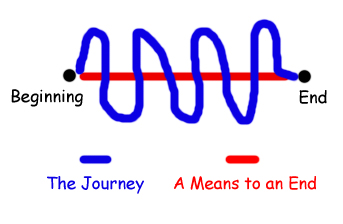
The Market is a Means, not an End


Even the greatest proponents of laissez faire economics would admit that the market is not an end, but rather a means.  Larry Kudlow's creed is "Free market capitalism is the best path to prosperity."  That's right, its a path!  So why have so many business leaders and financial media pundits attempted to create a belief that the market is something that must be preserved and nurtured?  Isn't the market merely the collection of opinions expressed by dollars?  If the government or the people choose to encumber, regulate or manage those opinions expressed in dollars is that not just another manifestation of the "market?"  Is not the choice to not encumber, regulate or manage those opinions expressed in dollars also a factor of the "market? Most importantly, does it even matter?

Welcome to the deepest depths of this blog to date.  A philosophical puzzle that seeks no solution other than to paint shades of gray that shall make the reader come to their own conclusion based in logic rather than borrowed rhetoric or sloppy undeveloped thoughts, if one hasn't done so to date.  In fact, if the reader is not prepared for this type of philosophical self-reflection, come back next week and I will be back to suggesting solutions to the chasms in our economy, politics and country.

The point:  The goal of any socioeconomic system, culture, government or process in general is a greater standard of living for its people.  In defining the concept of standard of living, one must not only count wealth, but the purpose that wealth serves.  In other words, standard of living is a mark on a barometer  which measures the ability of a population to live.  It begins on the low end with "attain what one needs" and culminates with "attain whatever one desires."  It is nonsensical, or rather simply incomplete, to state a standard of living is money or tangible goods because the logical question is money and tangible goods for what purpose?  It's money to be free, or it's money to exert power over people, or money to live a life of leisure, or money to create security, or whatever.  Its not the money, its the end that the money makes reality that is the intention or goal.

So, if money and tangible items are a vehicle, and the market is a vehicle to create or multiply that money, and the end is to maximize the standard of living of living of a population- the issue is thus centered around how we as citizens of a society get to that end in the most efficient and/or equitable manner.  Remember, this particular article does not have the purpose of solving what is the best path to reach our end, it's merely to silence the annoying undeveloped statements of many who believe that the market is the end.  

Two days ago I was reading an article from a brilliant financial planner who stated that the market shall prevail in destroying much of the Nation's wealth despite any efforts of the population to stave off such a doom through stimulus, the federal reserve and the treasury.  The purpose of this article is not to argue whether or not the stimulus plan shall work, or whether Keynesian economic tools are effective, its merely to disprove the careless careless conclusion of this highly respected professional.  If the market is not creating a greater standard of living, it is failing and not prevailing.  Remember, the market having its way is nothing more than a runaway car as the intended destination is an aggregate maximized standard of living (not to be confused with an equal standard of living for all which is the goal of communism).

Now I know many readers would argue that in the long run the market is the best path to the end of standard of living, but I argue today that the long run is a summation of successes and failures.  All I ask is that people admit that when the market is destroying wealth and creating a worse standard of living for those exposed to it, that it is in fact failing them at that time.  After all, we should not treat the market as a deity.  It is not always positive, it is not always correct.  It has always worked itself out of its troubles, but it is neither a good or evil, it just is.  In fact, the culmination of people's opinions as valued in money may not even be measurable as a provable existence.  The idea of "the market" might simply be an expression of the common statement "it is what it is."

Whether it's the best we've got or the best we can ever get, the market and the management of its consequences should never be without criticism or reflection.  The market deserves no sanctity or elevated stature.  Its merely a mechanism.  Sometimes it works to its intended purpose, sometimes not.  It is a very strong mechanism; but, nonetheless one for the purpose of making our collective lives better.   From here, the conclusion is yours to write.

Thursday, January 22, 2009

The stock market: Is it a trailing or leading indicator


Does the stock market predict things to come, or does it reflect things passed? Believe it or not, the answer is quite intuitive and simple. Stranger than that is that many financial planners, economists business leaders and stock analysts have it wrong. The answer is unavoidably that the stock market trails movement in the real economy.

How can this be? Everyday on the financial news it is taken as a given that the stock market is a predictor of the future of the economy and quite efficient in doing it. Such sources also tell us that the stock market is an efficient mechanism that reflects the true price of an asset or company based on the compilation of large sampling of peoples' opinions. Books such as The Wisdom of Crowds, by James Suroweiki, further state that large sample sizes of random guesses tend to better predict an unknown (such as an asset value or stock price) than an individual. Further, this school of thought has run a number of controlled tests that proved that a large sample size of random guesses is better at predicting an unknown than a small number of better equipped individuals (smarter or more experienced) who are collaborating to formulate a guess.

The fundamental premise is that information provided must be equal to all guessing.


It is a very small jump from this conclusion to state that markets best reflect the true value of an asset or company so long as information is freely available. People from this school of thought are most commonly referred to as Efficient Market Theorists (EMTs). Business programs predominately teach this method of market valuation to MBA students and the majority of players on the scene believe this to be true. So, if assuming EMT is correct, how can the market be a trailing indicator? Wouldn't it be a good predictor of the future?


Unfortunately not. The precipitous decline in the stock market in the fall of 2008 was clearly a reflection of the steady decline in the American economy beginning in the middle of 2007. The economy was sputtering in 2007, and financial analysts told the public nothing was wrong, and that if one separated the durables, autos, homes and mortgage business from the remainder of the economy everything was just fine. That was an incredible statement, and a terrible misrepresentation. It is common knowledge that durables, autos, and homes are the first indicator of a recession and as soon as they show declines, the entire economy shall follow. In fact, Alan Greenspan's company, prior to him becoming Federal Reserve Chairman, used to predict business cycles by simply tracking durables and automobile sales. That said, financial analysts, newscasters and government officials insisted that this was a "new" economy and such variables were no longer dispositive. Wrong. Funny how Greenspan, in his eighties nonetheless, predicted the recession within weeks.


The stock market continued on its upward trend throughout 2007 despite all prudent economists understanding a full blown recession would hit before the end of the year. Why was the market not reacting? The answer: denial and data.


1. Data

The first reason why the stock market is unable to predict future movements in the economy is that the prices are set by the purchase and sale of equities by analysts who base their decisions on data now known. The imperative here is that the prices are dependant on the reporting by companies of events that have already happened. Earnings, estimates and strategies released by companies are always released well after they have occurred. In other words, analysts, financial reporters, and traders receive data that has been processed by Board of Directors and executives for days, weeks and months. Therefore, it is an incontrovertible fact that stock prices trail real economic events. This reality is multiplied tenfold when the economy is recessing as companies will use deferrals and reserved profits from past expansions to buffer evidence of a slowdown in their business. The result, analysts and buyers are even further behind the curve of a bear market.

It is important to note that it isn't only business data that is slow to market, government data is painfully slow to market. One great example is jobless claims. First, one must admit that reducing capacity is one of the last cuts a business is to make. In most cases, businesses will begin cutting all areas that don't directly affect their ability to produce. As a result, necessary job cuts often come well too late in the business cycle as businesses must be sure demand won't rebound before diminishing capacity in the work force. The point is that the real economy has shifted and the financial news channels, traders, analysts and economists cannot see the shift. In other words, the government reports, which traders rely on to trade and invariably derive some picture of the future are more analogous to the wake than the boat.

In addition to equity reports and government reports lagging economic realities, commodity reports must be the least reliable of the bunch. A great example is OPEC. Cheating, overproducing and general market manipulation have created an environment where analysts and traders no longer trust forward announcements of OPEC. Analysts don't believe OPEC when they declare they will produce more oil to keep prices tolerable and they don't believe OPEC can restrain from producing at lower prices despite promises to do so to increase prices.
The net result is analysts, financial networks, and traders basing future decisions on inventory reports from the past. Worse yet, these reports are incapable of determining whether reserved supplies increased or decreased due to demand or supply. Regardless, players in this game determine how to bet based changes in the past.

In all fairness, I must state that many efficient market theorists would argue that traders, analysts and economists don't believe they are guessing at a future valuation of a company, but rather using the data to generate a prediction as to the present value of the company in real time. If that is the case, then the stock market is neither a trailing indicator or a leading indicator of the economy, but rather a barometer of the economy in that exact moment. That said, the general tendency of the market to wait for trends to emerge and the complimentary tendency to hesitate before declaring a change of trend leads to a conclusion that the stock market isn't even an efficient indicator of the current market.


2. Denial

The second reason why the stock market and asset prices always lag reality is because of momentum, or as I like to call it denial. Humans are creatures of habit. When things have been trending downward, people cannot imagine what it was like when things were growing. Vice-versa, when things are growing people cannot imagine a reversal as the common tendency is to believe "things are fundamentally different this time(commodity bubble, tech bubble, housing bubble, and soon to be the end of health care bubble)." As a result, analysts, brokers, traders and economists wait for a trend to emerge before declaring it safe to change direction.

That's right! Not only are these market participants basing decisions off of old data, once they see data signaling a change, such data is earmarked as an "aberration" until it duplicates itself. In the clearest sense people literally wait to buy once the real economics have turned more favorable and usually do so six to eight months after the company has realized the change in business.

The funniest part is that once the decision to purchase or sell is made, the real run of expansion or recession is well underway indicating that the reversal of that trend is closer than the market participants realize. As the price moves because of these transactions, it attracts more transactions in the same direction which most closely can be analogized to a stampede. This stampede always overshoots its target as the participants are watching old data and waiting in denial for trends. This creates the wild inefficiencies of markets in the short run, and also illuminates why 95% of the investing public ends up wrong all the time.

While I'm certain it is human nature to buy high and sell low because its the popular thing to do, its comical how we fear to act when the opportunity costs are low (prices are low because the majority are predicting further wealth destruction) and are so brave to act when the opposite is true. When the trend of past data is upward, indicative of a bull market, we as investors love to run directly off a cliff. Reminiscent of the old roadrunner cartoon, standing on nothing but air and filled with a false confidence by the reported data we believe to be a reliable prophecy of the future, there is no where to go but down.

Friday, January 9, 2009

National Security and Balancing the Current Account Deficit


Believe it or not, most people under the age of 40 don't even know what the current account is, much less how dangerous carrying a deficit is to our personal safety and the safety of our country. The current account is very simply the difference between exports and imports into our country. In other words, when a country exports more than it imports, the country has a positive current account, or a net export. When its imports exceed its exports, the opposite is true.


Most people don't pay a lot of attention to where a good is produced, assembled and its parts originate. However, it is a massively important factor to the overall safety of a Nation. In fact, Bismarck was qouted as stating, "Free trade is the weapon of the strongest (Makers of Modern Strategy, from Machiavelli to the Nuclear Age pg 223)." When a good is traded, or exported from the producing nation for payment, a number of crucial items are captured, most significantly 1. Greater Purchasing Power for their Currency, 2. Jobs, 3. Production Capacity, 4. Control of Natural Resources, 5. The Deflating of the Purchasing Countries Currency, 5. A General Tactical Strengthening of their Position in the world.


First, the purchase of a widget by a citizen of the United States from a foreign country, for our example Foreignland, causes a boost to the currency of Foreignland. This boost is caused because the US citizen is foregiong dollars for a good. Since that good was originated in a foreign country, the dollars received as payment are traded for the currency of Foreignland to compensate its workers, managers and profit margins. This trading of dollars for Foreignland currency causes the demand for dollars to fall and the resulting demand for Foreignland currency to rise. This causes an appreciation in the currency of Foreignland relative to the dollar and thus gives residents of Foreignland greater purchasing power for goods in dollars (real estate, automobiles, clothing or DVDs). In a functioning free market trade, the appreciation in the currency of Foreignland from goods sold to the United States would eventually lead to a reverse in the money flow as dollars become cheap and therefore the jobs, manufacturing, and goods would soon be produced in the United States as it is now more cost effective to build those goods in the US.


No big deal right? Right. Except, once a country enjoys the jobs, production capacity, control of natural resources, and general tactical strength over the purchsing country they are reluctant to allow the natural reversion to occur. Instead, the exporting country does everything in its power to hold its currency low, thus capturing all the dollars from the trade, as well as, the jobs, natural resources, and tactical strength. A perfect example is China. China refuses to allow their currency to appreciate by refusing to allow its currency to be freely traded or exported out of the country. China represses the market further by demanding that any import or foreign corporation be partnered with a Chinese firm with no less than 50% ownership in order to do business within the country. This is neither a dishonest or dishonorable action, it is statesmanship, albeit at the expense of industrialized countries such as the U.S..


That said, such behavior is not conducive to a free market. It creates a manipulated market with the majority of the societal rewards of trade favoring the country willing to assert itself. The sad reality is that the United States over the passed two decades has taken measured steps to eradicate any governmental regulation on trade so as to proliferate such results. Whether a naive pipe dream of free marketeers, a calculated manipulation by the upper 3% of the United States population to enrich themselves off of artificially underpriced labor, or pure laziness this lack of oversight by the United States as an entity have allowed trade to hinder its citizens rather than enrich them.


Worst yet, because of the number of U.S. dollars the Chinese hold in reserve, China is a significant military threat to the United States and its empire. Twenty years ago, China had no capability to manuever in the world, no economic might to purchase modern military technology, and was little more than a decentralized region of impoverished people. China certainly was not militarily ambitous or sophisticated enough to shoot down United States' satellites as a show of force (which happened in the summer of 2008). The enrichment from the dollars of U.S. citizens, gave the Chinese this capability. The dollars have literally built a formidable threat on the global scene with its own identity, cares, interests and ambitions. With every additional dollar, they grow relatively stronger and the United States relatively weaker.

Jobs, are the second great benefit of being a net exporter. These jobs represent a standard of living and the general contentness of a population. It is a given that a population without work is one which is without stability. Ghandi once stated that, "Violence occurs when there is wealth and no work." Many others have highlighted that there is a general tendancy of the classes to war when the working class of that society is not sustainable in nature. The great growth of the United States from 1941-1990 was the result of a vibrant manufacturing base and an economy where those willing to work were always afforded that oppurtunity. Without the abundance and demand for work, a society will begin to destroy itself from within. Therefore, it is not an exaggeration to state that the ability to import unilaterily into a country, is the ability to poison it.


An importing country becomes enslaved by the exporting country as its population is literally dependant on those imports so that they can resell them for industry (see article "The Float," this blog) and consume them for their sustenance. The exporter, thus, has the capablity to use their goods as a weapon to kill industries dependant on them. This type of attack by trade is an efficient means of asserting one's sovereignty as it devastates the morale of a target nation without having to spend military capital.


Production Capacity follows the same logic as jobs, except that it deals directly with materials instead of human capital. A country's ability to produce atrophes as its production dwindles. Very simply, when a country slows production it sheds equipment, factories, supplies and fixtures used to produce goods. Over a prolonged period, that shedding results in a lack of capacity to "ramp up" if necessary. Manufacturing is massively important in war as supplies and the ability to produce weapons, tanks, carriers and general supplies is a major factor in winning or losing. If a country forgoes capacity in times of peace, a great possibility exists that the lead time to ramp up for war becomes prohibitively long. Least we forget, the American automotive industry were the heroes of WWII as they answered the call of President Roosevelt to build sufficient planes and tanks to forge an attack against the Nazis.


It could not be more eloquently put than how Alexander Hamilton wrote it in his text book, Report on Manufacturers, the goal is to promote such manufactures....
" as will tend to render the United States independant of foreign nations for military and other essential supplies. [N]ot only the wealth but the independence and security of a country appear to be materially connected with the prosperity of manufactures. Every nation, with a view to those great objects, ought to endeavor to possess within itself, all the essentials of national supply. These comprise the means of subsistence, habitation, clothing and defense."

The general concept Hamilton proved was that free and unmanaged trade was a concept that only could succeed if somone was naive enough to believe war was no longer a real threat to the Nation. Economists and business leaders alike refuse to acknowledge this reality as it does not fit easily into their models of measuring profit and loss. Common sense nonetheless would assert that being conquered would trump any competing economic interest or argument asserted from that community. Thus, the balancing act between the benefits of trading between two parties of differing competitive advantages and protecting the soundness of the Nation is the operative standard of judging the best course of policy for a Nation.


Strangely enough, the father of free market capitalism, Adam Smith in his Wealth of Nations maintained,"the first duty of the sovereign was that of protecting the society from violence and invasion of other independent societies." As war was inherent in the understanding of any concept during the late 1700s, Smith was in favor of governmental regulation of international trade when that trade reached a level that was detrimental to the Nation's ability to protect itself in the world. It was Smith who said, "defense is of much more importance than opulence." After all, what is the point of trading if the end result is a net loss of its a Nation's sovereignty.


Control of Natural Resources is along the same lines of production capacity, but with respect to a specified class of items. Over the passed seven years the United States has experienced a tremendous run-up in the costs of natural resources. A significant reason for this run-up, aside from the speculation and margin buying by Wall Street (the reason for the 2007 commodity bubble), is the idustrialization of third world countries. Countries, such as India, China, Vietnam and South Korea had very little demand for oil, gasoline, heating oil, lumber, steel and concrete in the past; however, now due to increased demand for goods produced in these countries a need has been created. This need combined with the general depreciation of the US dollar, as a result of being a net importer of goods, has sufficiently lowered the standard of living of Americans in that they must pay more for essential items leaving less discretionary income available.

Further, this flow of limited natural resources to net exporters to the United States puts the US at the mercy of such countries in a time of conflict or disaster as they control the flow of commodities. For example, how would the United States react if attacked by an independent sovereign and in need of natural resources such as oil, steel, sugar and rubber, but the costs associated with getting those goods was extremely expensive because of a demand in China.  As a result, the United States looks to borrow or negotiate with the Chinese to acquire these items. In this example, assume the Chinese find an alliance with the attacking sovereignty more beneficial than one with the U.S. as the U.S. is vulnerable and without recourse. What would the United States do? Attack? No, we don't have the necessary resources to sustain such an attack. Maybe we could appeal to the business community who so profited off this trade arrangement, would they freely finance the war? Could they even if they wanted to?

Add all the above together and one can easily surmise why a net exporter will gain tactical advantage in the world. Net exporters very simply hold the power to destabilize the importing country from both the interior and the exterior. Eliminating social stability by devaluing the importing country's currency, eroding their substantive work force (substantive jobs are those that actually create a good, see The Float, on this blog), depleting their ability to acquire natural resources, reducing their capacity to wage war and capturing the importing country's reserves of currency all serve to empower the net exporter in the long run. These factors in addition to the forging of new trade and defense alliances with other sovereigns, as the net exporter grows in wealth and stature in the world, create an identity and ability to achieve its own ambitions.

Once strong enough, the United States can only appeal to the newly formed industrialized nation's sense of morality and fair play to achieve fair terms in dealings with them. This situation is the result of a comedy of errors by the stronger country to allow this situation to occur. During the strongest and most prolific years of the Roman Empire, independent sovereigns were reduced in stature to client states of the Roman Empire. These client states were strong enough to withstand their own populations from revolting and strong enough to withstand attacks from nomadic tribes , but never strong enough to pose a threat to the Empire itself. In exchange for surrendering their sovereignty, these client states received a better standard of living and support in protecting their lands from outside attackers. For the citizens of a client state being absorbed under the influence of Rome was a "good deal." They enjoyed peace, relatively stable commerce and a stable life. That said, ambition and ideas of becoming independent were not possible. Its not immoral or dishonest, it is responsible use of power for the greatest good of the citizens of the Empire. After all, isn't the entire point of government to provide a system and framework so that the citizens enjoy the greatest standard of living possible?

What about the "free market?" The answer is: what about it? Many simple citizens forget, or never understood, the free market is merely a mechanism of creating wealth and a standard of living for the citizens of a Sovereign. The free market provides no security to the citizens and clearly cannot exist without, at a minimum, the enforcement of criminal and property laws by the Sovereign. The Sovereignty of a nation is not subservient to a market, but rather the opposite is true. For without a Sovereign, the market cannot functionally exist. On this rationale, a market that serves to weaken and over time jeopardize the ability of that Sovereign to effectively maintain its ability to impose its will on the international scene is a market in need of adjustment for over time it will destroy itself by the same token.

Is the United States doomed? No. Strong leadership could reverse the current trend and restore its prowess in the world. The United States still can be the defining empire in the world, but strong statesmanship on behalf of its elected officials is necessary. Those officials must defy the urge to "do nothing" and allow the status quo to continue. Taking action would certainly force these officials to put the interests of America as a Nation in front of the interests of many powerful lobbyists who will invariably attempt to maintain this course of action. That said, officials must serve their country and citizens as a whole first. In acting in the best interest of the Nation, these officials will actually best serve those lobbyists as well, as their wishes are short-sighted and not sustainable in nature.

After all, the United States must act now while it still can sustain itself without importers. The United States should take back the wealth gifted to these countries by demanding fair ratio of 1:1 exports to imports.  Trading partners who fail to abide by this standard must be punished. The U.S. must support this stance with the full might of its military if necessary. If this occurs, the United States will clearly stand once again as an unchallenged power able to achieve its own ends in the world, peace, charity and abundance.






Monday, January 5, 2009

The Float: What does it truly mean to be a service based economy


Often times folks speak about the United States being a service based economy as a matter of fact and a simple meaningless truism.  While it is a fact that the United States is currently a service based economy, it certainly shouldn't be stated as an acceptable matter of fact.  This is not something to glaze over.  It is an unacceptable reality of decades of laziness that has lead our country to essentially zero growth since the early nineties.   

That's right zero growth.  Look at the value of any meaningful item (and by meaningful I mean substantial durables or assets).  Cars, homes, land and commercial real estate has made no meaningful appreciation.  No three percent per annum, in fact, the value of these are completely flat with the exception of a mountainous spike caused by monetary policy.  Believe it or not, after all the fury, we have made no progress.  How could this be?  Shouldn't our holdings at least have kept pace with the monstrous inflation we experienced up until 2007?

The answer is yes it should have, but no it didn't.  What the media, the government and economists don't want to tell you is that the "global economy" has stagnated our country.  The promise that every generation shall be better than the last is in jeopardy because policy makers don't understand that while globalization is wonderful for corporate profits in the short run, it devastates that same economy in the near term and eventually cripples a nation.  In the short run, exporting jobs to another country causes a company's cost of labor to decrease and even after the paying of shipping costs creates a larger margin for that company.  Those profits are usually invested by the company in new product or corporate investment vehicles that generate more profit for shareholders.  Certainly a desirable result.

Sometimes, a company will even pass along a share of the savings from the labor to the consumer, although this rarely happens as prices generally never fall regardless of where a product is produced.  A funny side note is that many Americans believe corporations pass on the savings from producing items out of the United States despite CPI figures clearly stating cost savings do not result in price reductions.  That said, greater profits derived from cheap outside labor does create greater profits that lead to higher stock prices, shareholder dividends, and greater CEO compensation.  Certainly a logical result.

The problem is that the behavior is short sighted.  It is the equivalent of killing a sheep for its wool.  Over time, the benefit of the exportation of labor gets piled into very few players in the economy.  The failure of a significant portion of the population to purchase anything due to nonavailability of substantive work leads to steep and severe recessions.  To remedy the recessions the government creates lax monetary policy to subsidize the inability of its citizens to function in the market as consumers.  This creates a vast number of service sector jobs centered around finance, sales, distribution, and logistics.  

Now the big problem comes.  The money from the lax standards purchases all it can and because the population does not create, build, develop or manufacture anything there are no jobs of substance that can continue to function.  The country stops buying at the current levels and the ripple effect literally shatters the economy shattering price levels back to pre-lax monetary policy levels.  Its all float, and that's what no one understands.

If all we do is sell to each other without any substantive jobs, there is no true production in our economy.  We cannot fall back on making diapers, toothpaste, clothing or pens.  If we were building these items, then those jobs would carry the service industry jobs through downturns and lead to the general increase in standard of living of all members of the country.  As population grows, those substantive jobs would grow in numbers and they would not be lost simply because the economy slows.  These jobs might slow, but not vanish.

The float is how Americans currently make a living.  They don't even truly sell anything.  Here it is in a nutshell: Joe American grabs his catalogue of foreign manufactured widgets and agrees tp sell them to Sam American for $10 a piece.  Once the order is placed Joe puts his order in and purchases those widgets for $5 a piece.   Joe isn't selling anything, just pushing through a meaningless profit margin.  Worse yet, as more players enter Joe's business his profits erode.  Since Joe has no power to innovate he will simply have to cut back on his standard of living to continue in his business- thus reducing the standard of living of everyone else that Joe interacts with.
 
Now, Joe paid for those widgets on  a line of credit from Clueless Bank of USA.  That's the float. Joe American and Clueless Bank of USA are on the seas of uncertainty.  Contract or not, if Sam American cannot pay because of a failure in his service based business, mostly because the "Joes" of society aren't buying from Sam because they have reduced spending due to the increased competition now in the "pushing profits" business, Joe is stuck paying interest.  If he cannot pay the principal or resell the widget Joe will default on the loan.  Clueless Bank of USA takes the loss which affects its ability to lend, creating a scenario which multiplies and duplicates itself by the cessation of credit lines to people similar to Joe American.

If everyone has jobs like Joe  American the economy is literally a string of dominoes with the tipping of the first domino leading to all of them falling in line.  This situation cannot sustain itself.  Can everyone see what is missing?  The creation of a good.  That's right a substantive business that literally performs a real function.  Turning plastic into containers or textiles into clothing.  These jobs are a necessity.  Someone must build the widget and when credit is extended to a company that builds widgets, at very least that bank has the widgets, machinery, real estate and assets necessary to build those widgets as collateral.  Further, that bank has the security of knowing that widgets must be made,  and if the business it loans to fails, someone must come and take their place to satisfy the citizens need for widgets.  This places a stability under the value for the companies assets.  Moreover, the workers at the widget factory create stability in the market for consumer goods and services as they are still working due to the demand for widgets.

In the case of the servicer, he has no purpose.  Anyone can sell the widgets.  Further, there is no meaningful collateral for the widgets especially because the bank's basis of $5 per unit is not the true cost, it is the true cost plus foreigner's profit plus shipping.  The bank is buried going into the transaction.  Moreover, we have no steady worker to buffer the loss of consumption during slowdowns in the economy.

From Rome to Great Britain, no great empire has sustained itself once it has engaged in free and directionless trade with foreign countries.  While it is true that trade empowers both parties with greater production and utility than could have been achieved without trade, economists never distinguish how that benefit breaks down between the parties.  In the case of super power and non industrialized country, the benefits are skewed dramatically in favor of the non industrialized country.  In the long run, the small gains of the industrialized country are significantly smaller than the gains of simply producing the goods unilaterally.  History has taught us this lesson with every great empire losing its stature subsequent to succumbing to mercantalists tendencies to trade away its production capacity.  

Trading allows the weaker country to gain relative strength against the stronger country.  Eventually that strength grows to bargaining power which leads to greater wealth.  Wealth leads to ambitions, and in time the smaller country shall be formidable companion with its own voice and identity.  Should that identity differ from the once greater trading partner the once strong empire shall find it has created a security; as well as, financial threat to itself.  If it continues the weaker party shall gain, not only identity but the will to oppose the stronger.

Like my good friend always said when we played bones, "Not all money is good money."  


Saturday, January 3, 2009

What is wrong with our economy?


As the 2009 year begins, this site shall provide timely guidance on how to make the economy of the United States viable and eventually vibrant in the long run. Today it is important for a short discussion on the proper diagnosis of what is wrong with our economy so that the proper cure can be developed.


The problem is very simply, deflation. While this word conjures terrible imagery and tends to carry a bundle of consequences that create fear and panic, one should not fear this diagnosis as it is accurate and can be remedied. Law makers, analysts and business leaders will never admit when an economy encounters deflation because it signals the complete failure of a market or economy. Deflation renders the actual market incapable of righting itself through mechanisms such as supply and demand, and necessitates intervention, whether by government, nature or large private players to reset the devastation.


For those not familiar with deflation I shall provide an example. This morning on the AOL homepage an article was titled "Don't buy a Camera Yet." The article went on to state that consumers should put off purchasing cameras, televisions, computers and other large electronic items as prices are sure to fall further. This behavior, while prudent perhaps, is deflationary as it incites hoarding by the population. It sends the message to hold your money as it shall be able to buy you more goods for the same amount later. Once the citizens decide that the "holding cost" of money is less than the fall in the costs of goods and services the death spiral begins. People stop spending and prices go lower. The problem is simply that as the price falls, people still don't buy so the price falls further.


This translates into an economic level where price falls and quantity falls as well. There is no supply and demand correction because price and quantity are no longer inversely related. In other words, price falls and the market does not react. Once the price falls below the cost to produce an item the seller no longer has an incentive to produce that good or service and the company shuts down leaving the market short of that good or service. At this point, the money hoarded by the citizens cannot buy that good as it is no longer produced. Deflation incentivize us as market participants to do nothing and produce nothing so as to prevent losing money.


Another great example of the deflationary environment we currently are experiencing is watching citizens fill their gas tanks half way, because they know they can fill the other half for less later in the week. This behavior, while prudent, shall lead to gas stations to slow or cease ordering gasoline to avoid taking losses. Sellers of gasoline can buy their inventory for less the very next day, and are punished for holding inventory. This leaves the citizen with shortages or without the product altogether at any price as the incentive is to not produce for the seller.


While terrifying, there are fixes. Generally speaking one can see that an economy must place a firm bottom under prices so that sellers can feel confident in producing a good or service. From that point a controlled increase in that price is necessary for a market to function on its own, inflation. Once citizens understand that an item shall not be reduced further in price, and rather, that same item will cost them more money in the future, they will begin to purchase. This translates into a conscious decision by the citizen to use an amount of their money while it still is able to purchase the good or service as it will take a greater amount of money to purchase the same amount in the future. The price increases allow the seller to make a profit and the seller is able to spend in return on innovation, labor and capacity thus creating greater production.


How does a market get fixed? Two ways. The first is that people magically gain confidence and start spending, which generally substantiates prices and creates price appreciation. This whimsical solution is very inexpensive, but not reliable as there is no guarantee it will occur before the entire production of a market is destroyed. Perhaps if the media created a positive environment people would psychologically react and mirror that environment. Studies have proven that people tend to act out the prognosis and tone of the "general consensus" of a population. As the media is the artery that provides the population with its "general consensus," whether agreeable to us or not, its message under this solution is key to the confidence of citizens. In fact, in our current situation it is amazing to note that the substantial fear amongst the population at large is centered around a threat that impacts very few of the total citizens (less than 8% unemployment, less than 2% of homes in foreclosure, FDIC limits of $2ook per account). Moreover, as the media has become increasingly more negative, the overall health of society has diminished and suicides have increased in step with the message.


That said, it is common knowledge that fear sells. Demanding the media change its message to fix the deflationary environment would be challenged by every media source as a violation of the First Amendment. Therefore, short of the media providing this market intervention against its self interest to save the greater good, another solution must be sought.


The second solution is to increase the Money Supply. Government spending, loaning and stimulus shall make the money that citizens are holding less valuable and eventually promote spending which will provide a price floor and an increase in prices in future years. It is not clear how the general citizen comes to understand that the holding cost of their money becomes expensive, but generally as a population sees citizens enriching themselves with goods and services as a result of more money circulating in the market, an increase in the general standard of living occurs in the short run.


The largest challenge to this solution is that it requires diligent monitoring by the Government so as to not create an over supply of money in the long run creating a jolt in prices once they have bottomed instead of a controlled price appreciation as desired. That said, this form of intervention shall certainly increase prices and solve the deflationary situation.


The second solution has been undertaken by the United States and the approximately four trillion dollars of stimulus provided between the TARP, Federal Reserve lending, Guarantees of Fannie and Freddie and a stimulus plan by the next administration to create three million new jobs will reverse the death spiral of deflation. The management of these programs will be crucial in the upside of the price appreciation to follow.


That said, isn't it interesting that both solutions provided here as well as any solution the reader may create will all entail people to act against their financial self interest and act in the greater good of the society or market as a whole. Perhaps the give and take relationship between self interest and common good are more relevant in a capitalist, or free market based economy, than society currently recognizes.