Saturday, March 14, 2009

The Healthcare Tax


There is so much argument surrounding health care and the future of the health care system in the United States that it is a difficult venture to take a stance.  Those for a capitalistic health care system argue that government involvement would stifle creation of alternative and new medicines as well as limit care among other things.  Those in favor of a government provided basic health care system argue that it is immoral to deny health care to any person and that the corresponding standardization of the industry will lead to better overall care.  One thing both sides can agree on is that the current system is dysfunctional and inefficient.

Assuming, the American is not a teacher, police officer, politician, in the military or a public servant who receives tax payor sponsored health care as a function of employment, the following is a depiction of the current system at work.  

Since the health care system in the United States is neither capitalistic nor universal, both sides are provided the luxury of blaming the other for the atrocious care available at a premium price.  If one is not poor enough to qualify for government health care, he or she is faced with bills for care that are unaffordable.  It is not uncommon for medical billings to include $25/Tylenol charges and $7,000 diagnostic surgeries (such as a biopsy).  Hospitals, Urgent Care Facilities, and private practices claim they are on the brink of insolvency and must charge exorbitant amounts to cover the costs of the uninsured who cannot afford medical attention. 

The current alternative for Americans is to purchase insurance at levels upwards of 15-20% of their take home pay monthly with $2500-$3000 yearly deductibles on co-pays and hospital bills with most preventative care excluded from coverage.  For families, the cost of an average HMO policy is over $500/month with a responsibility to pay up to $5000/year on deductibles before reaching an 80% coverage.  Year after year, the costs to remain insured rise. As those costs rise, the numbers of uninsured rise and system becomes more strained.  In fact, many Americans who are the most sick are denied coverage and deemed uninsurable forcing them to either attempt to deceive the system by lying on applications for coverage or becoming a ward of the health care system flooding the emergency rooms of hospitals.

For the trained economist, the resulting scenario is quite clearly an agency problem.  Much like in the scenario of public broadcasting, many take advantage of benefits for free, or "free-riding," while those who choose to pay cover the total costs.  In other words, an incentive to cheat exists as people recognize that by not insuring themselves they can still receive care.  At a minimum those uninsured settle their medical bills for far less money than what insureds pay, or avoid paying medical bills at all by bankruptcy protection or collection settlements.  As more people cheat, whether by choice or by necessity, the costs  to those who choose to insure grow exponentially as the medical industry charges higher costs to compensate for those whom they treat without compensation.  

Some Americans further believe that illegal immigrants also take a toll on the hospitals as they pay no taxes and carry no insurance.  While an identifiable target, 50% of American citizens pay no taxes and carry no insurance, so such points are taken, but not overwhelming.

The system can be summarized by "the few, or the insured, carrying the many, the 'un' and/or the under insured."  If one thinks about it, doesn't this sound familiar?  Ah yes, it resembles the American tax structure.  In fact, most insureds have health insurance costs taken directly out of their paycheck like taxes and the charges are taken out prior to State and Federal Taxes.  Further, the majority of the premiums and co-pays paid by the insured is not for the sole benefit of the insured, but rather for the benefit of the system as a whole.  Hmmmmmmmm, a payment directly taken out of a citizen's gross pay for the sustenance of  a common good or service. Yep, it's a tax, no doubt about it.

The biggest problem with this tax is that every year more people opt out of paying it, causing the tax to increase on those left who can actually afford it.  Worse yet, this tax has a massive profit margin built in for its "government," the Providers and Groups, who have an incentive to deny or reduce care to those who pay them to increase profits.  The collateral damage is directly focused on the hospitals who suffer to the point of insolvency as the growing class of uninsureds pile into emergency rooms that cannot turn them away.

While I shall not provide my reader with the solution because I believe solving this problem is quite simple and the solutions are plentiful once the issue is properly clarified, I urge the reader to weigh the following facts.  In the United States, many citizens don't see a doctor for preventative or procedural care due to costs.  Most citizens, won't even consider seeing a medical professional when sick.  Only when a health problem reaches a significant level of severity will the average American seek any medical care.  When a medical problem has reached the level of severity deemed appropriate by the average American to seek medical care, the treatment necessary is usually far more costly than it would have been at an earlier stage. 

Over thirty percent of health care costs and efforts are administrative fees associated with collecting and tracking payment from insurers and the government.  The United States is not even in the top ten in health, but it ranks number one in health care costs.  Health care costs are causing businesses to shutter and our competitive advantage in the world  to erode.  Finally medical bills cause more bankruptcies to our battered consumer than any other cause.

In closing, please consider that a dollar spent on health care has a worse multiplier effect than a dollar sent to the public sector in the form of taxes.  If a dollar spent at a local retailer shall lead to 8 dollars spent before that dollar is completely spent, health care, like taxes hovers in the low 3s as a multiplier because of all its sunk costs.  Once we as Americans admit that those paying for health insurance are simply paying a tax and that dollars spent on health care (like taxes) are less beneficial than other types of spending, we have begun down the path to a solution that benefits all.  Whether we eliminate insurance altogether in a purely capitalist structure forcing medical providers to charge fees in line with society's ability to pay, or induce a standardization of costs for the industry (i.e. 5 cents for a Tylenol, 10 cents for a bandage etc.), or create a single pay medical provider to eliminate the billing waste- the solutions are endless.  While some are more meritorious than others, the system chosen at a very minimum should force medical providers to focus on preventing serious illness as a manner to reduce costs and provide better care; as well as, protect the sanctity of life for all as priorities.  

One last thing, the argument that doctors and pharmaceutical innovators will leave the United States should a capitalist, standardized or a universal payor solution lead to lower pay for such persons is without substance. Where are they really going to go to find a higher wage than the United States?  Oh that's right, there is no where.

Monday, February 23, 2009

Public Private Partnerships: The future of the "free" market


tax receipts , greater population growth and a general increase in the standard of living of its resiedents municipalities became aggressive in competing for businesses. To grow their tax base, curbs, gutters, streets and incentives were funded by the cities for businesses. The reduction in sunk, or upfront made taken a chance on less established areas a less risky propositon. When those chances paid off, the result was a business incredibly formidable as it bore no carried costs of establishing itself. The game that ensued was one where businesses literally shopped incentives and costs of each municipaluty against the other to gain a competitive advantage.
In California, the battle became so fierce that the State Legislatues enacted a law prohibiting cities from stealing existing sales tax producing businesses from other municipalities within the State. The penalty was forfeiture of all bounty received from the relocated business back to the orignial city for a period of ten years.

While the new law stopped the spend to get, spend to keep and spend to maintain cities were forced to endure, the drive to incentivize was refocused on new businesses. Thus, the war rages on between revnue starved cities. All municipalities must follow suit if they want to keep their businesses viable. After all, modern business market participants must seize every advantage to merely survive.

While some may find outrage in the public sector becoming involved in the private market place, the reality is that those aggressive municipalities enjoy greater population growth, higher standards of living for residents and enhanced tax receipts. The benefits gained from incentives, makes such municipalities even stronger in the competition to lure businesses as they have more money to flaunt. A secondary public incentive market has thereby been created where the strong municipalities become stronger and the weak become weaker. A state of nature of sorts for the public sector. Those cities unwilling to participate with public money shall be without either public money nor private business (see city of San Bernardino and there decision to allow an auto mall and a shopping mall fail).

STATES

The same principle rings true for states. A perfect example is how the State of Arizona and the State of Michigan have literally removed billions of dollars from the State of California.

The State of Arizona formed an entire economic development campaign centered around picking businesses out of the high tax and highly regulated business environment of California. Arizona accomplished this by placing advertisements and sending recruits into California to make the case that business could be so much better across the border. Further, Arizona puts their money where their mouth is by offering free land, electricity and no taxes for a limited time to come see how good business is across the border. Further, by maintaining less than one third of the environmental prohibitions of California, businesses who move receive yet another subsidy. The net result: Arizona has more money to continue its efforts, California continues its course of self destruction.

Recently, the State of Michigan has found prosperity by competing with the state who refuses to compete. By offering a large tax credit to the movie industry for filming in Michigan and providing studios abandoned manufacturing plants for production facilities at no cost, Michigan has enjoyed significant economic stimulus usually reserved to Tinsel Town. Michigan boasts of over 40 films to be shot within its state in 2009. With dwindling margins from Internet access to movies, and a reduction of box office receipts, the help is welcomed by the studios once limited to the Hollywood Hills. The net result, Michigan is making money and starting to reinvent itself, California is losing ownership of its golden goose.

NATIONS

Every nation on the planet, with the exception of the United States, has been subsidizing its fundamental industries since the beginning of time. China subsidizes oil, gasoline, timber, and its banking system to provide Chinese businesses with a leg up on the global economy. China also violently controls its currency, wage laws and environmental laws to lure business into its borders so it can reap the benefits for the whole of its citizens.

Japan has furthered its imperialistic goals through trade since the dismantling of its imperial army at the end of the second World War. The Japanese literally stock pile dollars to keep the Yen artificially weak. The Japanese also subsidize its manufacturers by funding pensions, manipulating input costs and providing subsidized loans to further lower costs of production and increase those companies profitability.

England has a nationalized banking, health care and unemployment system which takes the burden off of their companies to provide such social services as terms of employment. Germany subsidizes steel, rubber and other components for its automotive companies which were literally capitalized and created by its government in the first place. Finally, Holland controls the number of market participants from clothing to ice cream to balance the benefits of both sustainability and competition.

With the birth of the multi-national company, the global economy has created nation-less bodies without allegiance to any flag or citizenry. They shop country to country for competitive advantages without care for the destruction they leave in their wake. These companies bring prosperity, revenue and increased standard of living when they come to a country and leave gaping holes of unemployment, abandonment and civil unrest when they leave. In every sense the public partner who corrals them enjoys the spoils of their operations. 

With the spending of every public dollar in Washington to bolster U.S. companies, the cry of the "capitalism for capitalism's sake" population cry with outrage. Time has passed them by. No other country on earth willingly sits idle as their businesses crumble. Especially when they compete in a market where public private partnerships have raised the stakes and lowered the costs. The cries of outdated Americans who claim government should "but out" are those who, not by their intentions, offer future American prosperity up for slaughter by foreign PPPs.

There is no other option. The US must stand as one with their business community and compete, least they be the Californias and San Bernardinos of the International scene. While markets do function well without interference, that time has long passed the human race. No foreign superpower is willing to accept the failure of its private sector for the sake of good old sportsmanship. Americans better wake up and start working together because there is no such thing as Santa Clause and there certainly isn't such thing as a private market. Whether we wish this to be different, or not, the stakes of the game are too high and the market too competitive for ingenuity and gumption alone.

Just as the United States won the revolutionary war by not standing in a straight line as proper etiquette of war demanded, other countries shall not allow their businesses to fail for the sake of decorum or idealistic rational. Commerce has changed, and with it Americans must toughen their stride, support their own and compete. Fighting with one hand behind its back, although admirable, is foolish.


Thursday, February 19, 2009

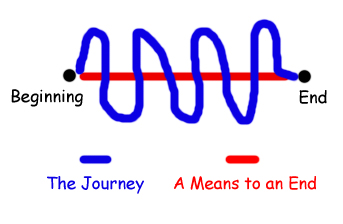
The Market is a Means, not an End


Even the greatest proponents of laissez faire economics would admit that the market is not an end, but rather a means.  Larry Kudlow's creed is "Free market capitalism is the best path to prosperity."  That's right, its a path!  So why have so many business leaders and financial media pundits attempted to create a belief that the market is something that must be preserved and nurtured?  Isn't the market merely the collection of opinions expressed by dollars?  If the government or the people choose to encumber, regulate or manage those opinions expressed in dollars is that not just another manifestation of the "market?"  Is not the choice to not encumber, regulate or manage those opinions expressed in dollars also a factor of the "market? Most importantly, does it even matter?

Welcome to the deepest depths of this blog to date.  A philosophical puzzle that seeks no solution other than to paint shades of gray that shall make the reader come to their own conclusion based in logic rather than borrowed rhetoric or sloppy undeveloped thoughts, if one hasn't done so to date.  In fact, if the reader is not prepared for this type of philosophical self-reflection, come back next week and I will be back to suggesting solutions to the chasms in our economy, politics and country.

The point:  The goal of any socioeconomic system, culture, government or process in general is a greater standard of living for its people.  In defining the concept of standard of living, one must not only count wealth, but the purpose that wealth serves.  In other words, standard of living is a mark on a barometer  which measures the ability of a population to live.  It begins on the low end with "attain what one needs" and culminates with "attain whatever one desires."  It is nonsensical, or rather simply incomplete, to state a standard of living is money or tangible goods because the logical question is money and tangible goods for what purpose?  It's money to be free, or it's money to exert power over people, or money to live a life of leisure, or money to create security, or whatever.  Its not the money, its the end that the money makes reality that is the intention or goal.

So, if money and tangible items are a vehicle, and the market is a vehicle to create or multiply that money, and the end is to maximize the standard of living of living of a population- the issue is thus centered around how we as citizens of a society get to that end in the most efficient and/or equitable manner.  Remember, this particular article does not have the purpose of solving what is the best path to reach our end, it's merely to silence the annoying undeveloped statements of many who believe that the market is the end.  

Two days ago I was reading an article from a brilliant financial planner who stated that the market shall prevail in destroying much of the Nation's wealth despite any efforts of the population to stave off such a doom through stimulus, the federal reserve and the treasury.  The purpose of this article is not to argue whether or not the stimulus plan shall work, or whether Keynesian economic tools are effective, its merely to disprove the careless careless conclusion of this highly respected professional.  If the market is not creating a greater standard of living, it is failing and not prevailing.  Remember, the market having its way is nothing more than a runaway car as the intended destination is an aggregate maximized standard of living (not to be confused with an equal standard of living for all which is the goal of communism).

Now I know many readers would argue that in the long run the market is the best path to the end of standard of living, but I argue today that the long run is a summation of successes and failures.  All I ask is that people admit that when the market is destroying wealth and creating a worse standard of living for those exposed to it, that it is in fact failing them at that time.  After all, we should not treat the market as a deity.  It is not always positive, it is not always correct.  It has always worked itself out of its troubles, but it is neither a good or evil, it just is.  In fact, the culmination of people's opinions as valued in money may not even be measurable as a provable existence.  The idea of "the market" might simply be an expression of the common statement "it is what it is."

Whether it's the best we've got or the best we can ever get, the market and the management of its consequences should never be without criticism or reflection.  The market deserves no sanctity or elevated stature.  Its merely a mechanism.  Sometimes it works to its intended purpose, sometimes not.  It is a very strong mechanism; but, nonetheless one for the purpose of making our collective lives better.   From here, the conclusion is yours to write.

Saturday, February 14, 2009

Fixing California is Simple, Fixing Sacramento is not: The General Concept


While California's elected officials debate a massive tax increase and spending caps in Sacramento, neither party is happy with the course of action proposed.  Further, arguments from both sides ignore well established principles of statesmanship and economics and very clearly will not improve the position of the State regardless.  

The State currently has a projected budget deficit upward of $40 billion dollars and legislators are engaged in the classic push and pull of cutting spending and raising revenue.  The reality is that the simple minded solutions of raising taxes for revenue creation and cutting government workers' wages for a spending solution both have contrary effects to the desired result.  The desired result is for the State is to create a situation where revenue is at least equal to expenditures if not greater.

Raising Revenue

Raising revenue is not as simple of a concept as the majority of people think.  In fact, many politicians believe that increasing taxes will increase revenue to the State.  While this seems intuitive it is not reality.  In fact, such a belief is the equivalent of a business raising prices to increase its revenue.   The reality is that life isn't that simple.  According to proven economic principles, raising taxes beyond a certain point actually has an inverse effect on a state's revenue as people no longer have the ability or the apatite to pay such taxes.  Therefore, there are certain scenarios where actually lowering taxes will lead to greater revenue realized.

This economic certainty, as developed by Arthur Laffer  and proved by successful U.S. policy in the 1960s and early 1980s,  is unchallenged in theory by any economist despite its critics disputing where the maximum revenue point is in relation to tax rate.  In essence, Laffer surmised that the amount of revenue the government collects is a function of the tax rate.  In building his model, named the Laffer Curve,  Arthur Laffer concluded that a State can raise revenue by raising taxes only to a certain point, at which, any further increase in taxes will actually lead to a fall in total revenue.  As a result, there is a point between a tax rate of 0% and 100% where a given tax rate equates to maximum revenue.  The debate has always ensued as to where that point actually exists.  

While I would argue that the tax rate to generate maximum revenue actually moves depending on the psychology of the market and the position of the economy in the business cycle, few would disagree that temporary identifiable reduction in the price of any good, will cause an increase in sales if the public believes that price reduction is both significant and temporary.  If one will indulge that taxes, such as sales tax, are a function of the price paid for goods, then why wouldn't a temporary reduction in sales tax lead to greater sales?  

With greater sales, the State would receive more total revenue dollars and greater income tax as businesses would encounter more revenue.  This doubling of total tax revenue would be substantially greater than an increase in that tax which will discourage spending and dilute the effect of the raised tax.  Further, the resulting decrease in spending un reaction to the proposed tax increases would cause further reductions  in revenues to businesses and lead to reduced income tax receipts.

As a result, the first prong to the solution to the budget in the short run is to identify a fixed window, maybe seven months, where purchasers will pay a reduction in sales tax of 1.5%.  If this is advertised as significant and is promised as temporary, sales tax total revenue will increase.  This principle is tried and true, just ask any retailer about increased revenue during an effective sale.  The State also will enjoy the secondary effect of higher employment, and greater income tax revenue.

Spending

While it is true some spending cuts should be made to balance the budget, the State should not cut its nose off despite its face.  Spending that is directly converted into income for an individual is the worst place for the State to cut.  Why?  First, the worker pays taxes on those wages.  Second, the worker spends those wages leading to sales tax receipts to the State.  Finally, the purchases that those workers make, as a result of the government spending to them in the form of wages, leads to revenues in the general economy that leads to profits, that are taxed, and job creation, that also generate tax.  In essence, don't cut spending that leads to revenue.

The State must cut spending that is least effectively turned into personal consumption, at least in the short run.  Therefore, immediately the State should forgo any spending that is material intensive. A majority of such spending will be lost in commodity costs rather than spent into the economy with a multiplier.  Next, the State in the short run should not expend energy or spending on any type of regulation, environmental or otherwise, that inhibits job creation, business creation, and economic growth.  The State can always reinstall such efforts when its citizens are in a healthier situation.  After all, anyone who states that a two year hiatus from cumbersome State regulation will have a significant effect on the landscape of the State in the long run is simple and short sighted.


Conclusion

There it is, a concise framework for a healthy budget in the short run.  This fix will buy legislators time to build a long term sustainable path to prosperity in the State.  In the long run, I believe that a strong emphasis should be on revenue creation through economic development and building an attractive landscape of low corporate tax rates and simplified State regulation to attract and maintain employers, manufacturers and business innovation. As the State already has a competitive advantage in living standards, weather and natural beauty, a favorable business environment would create a sustainable and growing tax base.

 The funny thing is that the short run fix to the budget imbalance is contrary to the beliefs of both parties.  I am sure that it is no surprise to the citizens that the political parties have improperly framed the arguments of how to resolve the budget crisis, after all they stopped representing citizens in favor of well funded special interests many years ago.  That said if we can accomplish the difficult part, convincing the elected officials to act in compliance with proven and established proofs of economics, a solution is literally before us. 

Saturday, February 7, 2009

The Fix


"Fix it, Fix it!" yells the financial pundit on Saturday Night Live's Weekend Update when commenting on the economy.  Without being presumptuous I believe that all of us echo this sentiment when we reflect on the disjointedness of the economy.  Nothing seems to fit and anxiety is causing a dangerous reluctance among consumers.  So that said, what's the fix?

The fix is actually very simple in theory.  The run up in prices that occurred during the reckless extension of credit from 2001-2006 was not accompanied with equal wage appreciation.  The net result was the extension of credit that the borrower ultimately could not afford.  Prices were thus inflated beyond the means of population, and the only possible effects were a fall in prices to meet wages or an increase in wages to meet the prices.  On the back of massive foreclosures, repossessions and short sales accompanied by wage deflation caused by a foolish reliance on globalization of labor the former occurred.

Now I realize this is quite intuitive, but the solution is bringing prices and wages into equilibrium.  Our choices are 1. allow deflation to continue until the price for goods has fallen to a level where those left with jobs can afford assets in cash or 2. create across the board inflation so that wages increase as well as prices.  If number two is picked, the government must slow inflation once prices reach the desired equilibrium least we be faced with run-away inflation.

Choice 1

Deflation is a monster that destroys everything in its path.  It is the worst thing that can happen to an economy as it counteracts the whole purpose of free market capitalism, wealth creation.  Unchecked, deflation can continue for a decade to  a generation stifling innovation and punishing production (see What's Wrong with Our Economy, this Blog).  In the quickest summation, prices fall and the population still will not purchase.  Businesses fire workers or shutter their operations as they cannot convince consumers to consume.  As businesses close, prices fall further and eventually the production of goods is no longer profitable as the market is littered with unsold inventory.  More unemployment and wage decreases ensue.  Investments, homes and large holdings continue to lose value as the falling wages cannot afford once affordable prices.  This destruction in wealth cools more innovation as banks are not comfortable to lend and people with cash wait for prices to fall further.  Therefore, wage and price reach equilibrium somewhere down the road of massive wealth destruction.  At this point, prices can once again gradually appreciate.

The two problems with allowing this solution is that it can take an extended period of time and civil unrest is very likely.  Under this scenario unemployment will be very high before it corrects, 20-35%.  Markets will not function normally and frustration of the population will create a dangerous scenario.

Choice 2

Since the Great Depression free market capitalism has bee dominated by a school of thought in conjunction with the battle cry of John Maynard Keynes, "in the long run, we are all dead."  The government in using this school of thought has two major tools to set the economy back into equilibrium.  The first is monetary policy.  With the Fed Funds target rate at one quarter percent, clearly interest rates are not having traction against the massive pull back of financial institutions and consumers.  The second tool is fiscal policy.

Fiscal policy comes in two categories 1. direct and 2. indirect spending.  Direct spending is literally the government filling in as the spender of last resort and directly spending money to create the recirculation of money in the economy and reflate prices.  The second category is usually in the form of reduced regulation or reducing taxes, leaving more money in market participants pockets which they can spend and reflate prices.  There is much debate over which of the categories are more effective, but both by definition will stimulate the economy  as there are literally more dollars available in the market.  

As the dollars are spent, the multiplier effect will take place in which one dollar spent will literally be passed from one participant to another up to eight times.  Prices will inflate, and wages should increase with increased profits; that is, so long as corporate policy commits to  American labor (see the Float).


Whether one prefers Choice 1 or Choice 2 the limiting factor is time.  This commentary shall not attempt to differentiate between any of the alternatives suggested as that is a complex argument for another article.  For now I wanted to simply identify the issues we are facing and intelligently explain the possible fixes.  Without bias I will close by stating that it is doubtful the American population has the patience and tolerance to undergo what Choice 1 would take to reach equilibrium.  For now let it suffice that the market disjunction shall be fixed and the how is literally in Americans hands.

Wednesday, January 28, 2009

The Accounting Crisis: Mark to market and the Destruction of the U.S. Banking System


Did you ever see the Stephen King movie The Happening, where people throughout New York City are committing suicide in mass? You see people literally turning on themselves to end their own lives as a result of some strange spore released into the air by plants protecting their existence. Well, if you think about it this is analogous to the current destruction underway in the financial system of the United States. Banks literally are turning the knife on themselves by sheepish lending practice while the accounting rule of mark to market is silently spreading to induce the massive death and destruction.


Mark to market is a rule whereby publicly traded companies must "mark," or declare, the value of their assets to what it would be worth if it was to be sold at that very moment. This rule, while widely used in valuing liquid assets such as securities was applied to nonliquid assets, such as real estate, after the Enron scandal. The general hypothesis towards applying the rule to nonliquid and liquid assets alike is to prevent companies from misleading investors by valuing its held assets at higher price than their "real" value.


The problem in the banking world is that banks are regulated stringently by the Federal Government and must maintain a certain ratio of assets to loans to be considered legally solvent. The result is that when a bank must mark its assets down according to the accounting rule, it is legally required to cover that write-down by adding another asset, usually cash, or decrease the number of loans it has outstanding. Since their is no practical way to call loans, banks must raise additional cash when the marketability of their assets fall regardless of whether those assets are performing perfectly.


Approximately 2.5-6% of home mortgages are in foreclosure. A staggering number, but not insurmountable. Now add that under 50% of Americans have a mortgage on their home. What do you come up with? Yes, you're right! The banking crisis has less to do with the foreclosures and more to do with arbitrary accounting rules. As infuriating as the truth is, the mark-to market accounting rule is forcing banks to value the homes that they hold mortgages on down to the values being received in foreclosure sales representing somewhere between 1.25%-3% of total homes!  Even if one intends to pay every last payment of one's mortgage with the paycheck from one's stable Federal government job, and that mortgage payment is less than 25% of one's take home pay, the bank has to value that home as if foreclosing on it today.  

The mark to market rule literally created the same bubble it is bursting.  When the market was trending to the moon in 2002-2005, banks were allowed to mark the assets up to the market price.  This increased the assets on their balance sheets and created more room for lending, thus pushing prices higher as more credit was made available.  This sinful consequence flew in the face of sound accounting where gains on illiquid assets are not to be realized until sold.  Subsequently, as prices began to fall, banks "marked" their assets lower limiting their ability to lend, which limited credit and prices fell further.  Once prices fell further, the banks had curtail lending more and guess what?-Prices fell further.  The sad reality is that the houses being sold determining this market value were not sold by choice, but rather as a result of foreclosure and therefore no true market existed.  Further, with buyers unable to access credit because of banks having to hoard cash to make up for falling values on assets (95-97% of which were performing) fewer transactions occurred to stabilize prices.

Here is the rub, foreclosures had very little to do with the financial crisis, accounting and fear were the culprits, and I can prove it.  If Bank A foreclosed on house 1 previously valued at $250,000, Bank A would not have to mark that asset down so long as they issued a new loan to the next Buyer at $250,000.  Even if the next buyer couldn't afford the house and would subsequently go bad on the loan in one year, the asset value by rule would be $250,000.  As a result, it was lenders unwillingness to lend that literally caused their inability to lend.

Clearly I understand that the moral hazard associated with the securitization of mortgages, relaxed standards by Freddie and Fannie and outright fraud caused much of the bubble of the housing market,  but the illogical extension of marking illiquid assets to the market amplified the problem from a rising market to a bubble and then from  a declining market to a catastrophe. 

 A great example of how the market rule amplifies itself occurred when Wamu was deemed insolvent by the FDIC and Chase Financial was given Federal assistance to take over the massive mortgage lender.  In taking over Wamu, Chase marked all of the acquired mortgages down to what Chase and regulators deemed a palatable level.  Regardless of whether or not the mortgages were performing, Chase marked them down as if they were to be sold that very day according to the accounting rule.  Almost immediately following this transaction Wachovia was on the brink of insolvency as a result of how Chase had discounted the assets.  All the experts agreed that there was no market for new homes and that the most difficult issue facing Wall St. and banks was how to put a value on them.  Wachovia was profitable.  Their loans were performing. Mark to market killed Wachovia because of how Chase valued the assets of Wamu in the forced sale.

Solution:  An illiquid asset is worth whatever it is originated at and at its sale, disposition, trade or disposal a gain or loss is to be recorded.  No matter what the system for valuing assets it will never be perfect, but surely it can be without unintended exaggeration.  After all accounting is supposed to illustrate reality, not create it.