Monday, April 27, 2009

Realizing the Economic Cost of Losing Common Thought


Many can recall a time in the United States when an American could count on his fellow citizen to look out for what was right. Americans left their doors open, shared, belonged to a neighborhood and looked after one another's children. Americans went to Church and bought war bonds. For simplicity sake, Americans took responsibility for themselves, their family and their community. They acted in a manner that was not only beneficial individually, but also for the benefit of the common good of each other and the Nation as a whole. There was a definition of what it meant to be American.


Environmentalists argue that a Nation must force a company that pollutes to pay for its down stream effects, or the costs bore by the population in dealing with such pollution. While I can't say that I agree completely with this theory when we are discussing environmental issues, it is an interesting framework when conceptualizing our short falls as a Nation.


While I believe Americans, whether Democrat, Republican or Independent legitimately would prefer less government, they believe, albeit in different respects, government is necessary to fill the gaps. Government has grown progressively under every party's government over the last thirty years, yet our problems seem to be greater than ever. Why?


I would suggest it is our failure to take responsibility as a whole that has created the shortfall. Our decision to legislate the problems away have created resentment and hostility towards such legislation. As the intervening third party, the government, becomes the arbitrator and enforcer of disputes. It is this third party validation or disapproval that creates entitlement and angst among Americans who feel like "right" is being jammed upon them. That said, the argument for whether government should enforce these social shortfalls is not productive in addressing the true issue, which is of substance over procedure.


When Americans fail to buy American they harm Americans by undermining the working class of America. When Americans cannot sustain meaningful work because they compete with currency manipulated government subsidized slave labor from abroad. Two incomes become necessary to manage an American household. With no parent at home, schools are burdened with the costs of teaching children how to be adults as well as math and science. The cost of education increases because schools are dealing with under prepared children who need to be taught things that are not meant to be taught on the tax payers dime. Taxes get raised to subsidize the lack of parenting, and families get squeezed even further creating resent. That resent is communicated to the children in the form of teaching them to be tough and to look out for themselves least they be left in the situation of their parents. The children serve no master, but themselves, and are without a sense of right and wrong. Church is cast aside, and the race to compete for the now creates an aggressive environment where fellow countrymen are willing to tear each other limb from limb to pacify their desires for earthly pleasures. What can you make of this rant?


Action of pure self interest without consideration for its "down stream effect" shall carry certain unintended consequences over time. While I am not suggesting that Americans legislate the International 4-Point Test of Rotarians; and in fact, I suggest legislation shall not solve a bit of these ills, I will say that failure to change our actions shall invariably lead to greater social costs and greater regulation. Not allowed to censure the profane, no prayer in school, uninterested in a solution for the sick and the meek, not willing to tithe 10% of one's income, disallowing a neighbor to discipline one's children, no greater sense of right and wrong, forging income on a home loan, selling irresponsibly, buying irresponsibly and forgetting that Americans are responsible to maintain the health of our whole economy are just a few of the items on the table in this discussion.


Serving the dollar as thy master without consequence ensures that no individual shall enjoy financial security in the long run. Similar to the old adage, "live by the sword, die by the sword," live selfishly and thy shall receive the same in kind. There is plenty of room for profit, morality, patriotism and an obligation to act in a manner which is best for all involved. The cry that these concepts are mutually exclusive is lazy, and the underlying belief that "right" depends on one's perspective is untrue and sarcastic.


In closing, saving $2 on a tee shirt or $45 on a laptop through the purchasing of imports is not worth creating an economy where no one has enough money to purchase anything from you in return. The downstream effects of acting without consideration is the desecration of a community. Just as one can shear the wool from a sheep for his or her lifetime, he or she can only kill it once. Be good to Americans, so they can be good to you- Lord knows you shouldn't need the government to tell you to provide for one another.


Friday, April 10, 2009

The Conversation We Need to Have


Wage disparity, the slimming of the American middle class, the strengthening of the multinational corporation and the record breaking bonuses of CEOs are all occurring simultaneously in the United States. The threat of wealth redistribution and government intervention are topics that have become common place. Divergence in the media where Americans can choose their slant by switching the channel, but never get a straight answer is all that is available. Finally, a growing majority of America's youth who believe they shall not be able to achieve the socioeconomic status of their parents is significant.

How did this Country who banned together to win: two world wars, a four decade cold war for global supremacy, and the race to the moon become so demoralized? Where did the tough- nosed honest gumption of this population go? It wasn't long ago when an experiment comprised of an enmeshment of immigrants found a common purpose in the burgeoning of an industrial revolution and understood that together they could conquer any challenge. It was against this backdrop Henry Ford declared he "paid his workers well so they could afford to buy one of his cars." Every neighborhood was adorned by a corner market where a family could make a living serving their block as a local grocer. These were the days when doctors would make a house call, and one paid the bill with what he or she had in his or her wallet. Americans left their doors unlocked and finding work was attainable for those who were willing to work.

In these golden days, buying local and buying American was the standard, and foreign labor and outsiders were viewed with skepticism. These Americans believed in honesty, family and Country. This was the era where the boy with a work ethic and a dream could move from the mail room of a company to becoming the CEO. People believed that hard work would lead to upward mobility in society. In these days, bankers let borrowers meet with them face to face, a worker knew the owner, and neighborhoods policed themselves.

America today is in transition. The ghosts of Marx and Schumpeter look over us with parsed lips and a wry smile in a gesture of "told you so." Prices and wages diverged throughout the 2000s culminating in a freezing of the credit markets. In the simplest description, trust between the classes seized in a long coming day of reckoning. If one acknowledges that credit is a bridge extended to someone in need of more money by someone, or some entity, that possesses it, than it becomes obvious why the credit markets seized. Those "without" no longer could afford their current course of consumption. Credit was extended to supplement this shortage, but soon, those "without" could no longer afford to service the necessary debt. Frankly speaking, the wages had fallen far too short of the prices of society. The culmination was $4.50/gallon gasoline and median home prices of $300,000 on an average household income with two working parents of under $45,000/year.

Now it is commonly acknowledged as fact that globalization caused the wage deflation, or at a minimum wage stagnation, in the United States (Thomas Friedman, The World is Flat, Alan Greenspan, The Age of Turbulence, Common Cents, The Current Account Deficit and National Security). American companies became part of the "multinational" corporate model where labor was sought in an environment where a competitive advantage existed regardless of nationality. United States labor laws, environmental regulations, labor unions, and high corporate taxation cemented this outsourcing of labor. In addition, failure to enforce Anti-Trust laws allowed Corporations to reach a size that eliminated competition. An example is Walmart, who breaches contract law with suppliers, drives down wages by forcing competitors to close and subsidizes its low costs by paying wages so low that the workers are encouraged to accept Federal and State welfare for health care instead of the Company's group policy. Most intelligent business people refuse to supply, build or service companies of this size because such Goliaths slow pay and renegotiate contracts as a business practice and ultimately drive their business partners into insolvency.

So after all of the above, what conversation needs to take place? A one on one conversation, nationally televised without commercial, commentary or spin between an American CEO and an American worker. No government, no labor union, no chamber of commerce and no company delegates permitted. Like the doctor on a house call when it was time to settle the bill, business leader and worker need to see one another from a perspective of humanity. Just two brothers of Country, who have avoided one another, speaking only through third parties, for a significant period of time and act with malice despite forgetting how their relationship became so strained. The American worker needs to know what they can do to earn the trust of the American upper class. The American upper class needs to understand that regardless of why they have betrayed the trust of their Country when they chose to export the dignity of work overseas, they will be stronger once such a trend is reversed.

In having this conversation their should be no third party interference, as just in a sibling rivalry, such interference shall cause resentment and defensiveness on the party who feels outnumbered. The wealthy need to soften in resolve with the real needs of the worker and the worker needs to understand and respect the pressure facing the business. Picture it. Two people, who have grown to dislike one another and have refused to directly communicate for decades, locked in a room until they come to a mutually agreeable solution. A solution to bring the United States back into alignment. No longer should the youth be conditioned with a fear of being outsourced by fellow countrymen. No longer should the wealthy feel that those without are spoiled and not willing to work and earn their way to a point of financial security.

My suggestion is metaphorical, symbolic and allegorical; but, drives at the core of our current crisis of credit, unemployment, confidence and patriotism. There has been far too much taking in our culture and entirely too little giving. Giving of employment, giving of opportunity, giving of self and giving of dignity. Government cannot solve our situation without the agreement of those who are able to give these things. The cry of the wealthy that "if the government is to redistribute wealth they shall denounce their Country and take their capital and toys elsewhere" is understandable. Forcing a party to act never ends amicably. The cry of the working class of unfairness is counterproductive, for we need no further sleuthing for problems. We need a solution. A dialogue of how these parties can best participate together.

After all, their existence within the borders of this Country is symbiotic. The worker needs the wealthy for wages, the middle class needs the worker for advancement and the wealthy needs the middle class for sustenance of their situation.

Wednesday, April 1, 2009

PROBLEM SOLVED!!!!!


Just a quick note.  Have you ever wondered what happened to the old fashioned problem solving nature of the American public?  The attitude that no mountain was too high and no valley to low.  The resolve that made our country eternally optimistic and willing to believe in the motto: "Work hard and you shall be rewarded."

When was the last time the media dared to declare a problem was solved?  What would you do if the evening news began with a story with the headline "PROBLEM SOLVED!"  Is it possible?  Have the passed thirty years, thirty months, thirty days and thirty minutes been without any success?  Have we turned into whining, snivling, problem finders or are we still ingenuitive problem solvers?

I suggest Americans are worthy of more credit than the media would ever be willing to give them.  Moreover, I believe if one is only looking for problems, that's all they shall find.  That said, the mindless twenty-four hour reporting of actual and potential problems seems counter productive.  In fact, this endless search to uncover problems is even less productive than the endless stream of "news analysts" that are paraded in front of the general public to interpret the facts.  This behavior is literally story telling for adults and permission to create facts out of conjecture.  

Funny as this sounds, CNN created a word cloud to illuminate on the President's speech last week.  Love President Obama or hate him, he is direct, clear and unambiguous when he speaks.  There is no need to interpret.  That said, assuming news sources needed to fill empty time by rewording the speech, a contemporary illustration made up of all the words used in the speech with the words used most frequently appearing in the largest font is simply silly.  The analysts dissecting the word cloud to find the greatest sense of meaning was even more outlandish. Is this productive?  Is it genuine? What happened to simply listening to the source to figure out what they meant? 

With the news transitioning from informative to entertaining, it dangerously borders on being purposely misleading.  The largest worry is that many Americans believe news sources are bound by certain protocols to report facts.  The media has wandered astray and with it so has the focus of America.  The news has created fear in every man, woman and child in a torrent of problems.  They have changed the lending practices of banks and the willingness of people to invest by the constant bombarding of negativity and their endless search for troubling data, potential problems, and what ifs.  While the media is free to write and broadcast as they wish, a greater sense of common good and Country demands the reporting of our numerous achievements in at least equal frequency to our shortcomings.  After all, wasn't America a better place when Mickey Mantle was a hero and  American companies were the envy of the world?

Saturday, March 14, 2009

The Healthcare Tax


There is so much argument surrounding health care and the future of the health care system in the United States that it is a difficult venture to take a stance.  Those for a capitalistic health care system argue that government involvement would stifle creation of alternative and new medicines as well as limit care among other things.  Those in favor of a government provided basic health care system argue that it is immoral to deny health care to any person and that the corresponding standardization of the industry will lead to better overall care.  One thing both sides can agree on is that the current system is dysfunctional and inefficient.

Assuming, the American is not a teacher, police officer, politician, in the military or a public servant who receives tax payor sponsored health care as a function of employment, the following is a depiction of the current system at work.  

Since the health care system in the United States is neither capitalistic nor universal, both sides are provided the luxury of blaming the other for the atrocious care available at a premium price.  If one is not poor enough to qualify for government health care, he or she is faced with bills for care that are unaffordable.  It is not uncommon for medical billings to include $25/Tylenol charges and $7,000 diagnostic surgeries (such as a biopsy).  Hospitals, Urgent Care Facilities, and private practices claim they are on the brink of insolvency and must charge exorbitant amounts to cover the costs of the uninsured who cannot afford medical attention. 

The current alternative for Americans is to purchase insurance at levels upwards of 15-20% of their take home pay monthly with $2500-$3000 yearly deductibles on co-pays and hospital bills with most preventative care excluded from coverage.  For families, the cost of an average HMO policy is over $500/month with a responsibility to pay up to $5000/year on deductibles before reaching an 80% coverage.  Year after year, the costs to remain insured rise. As those costs rise, the numbers of uninsured rise and system becomes more strained.  In fact, many Americans who are the most sick are denied coverage and deemed uninsurable forcing them to either attempt to deceive the system by lying on applications for coverage or becoming a ward of the health care system flooding the emergency rooms of hospitals.

For the trained economist, the resulting scenario is quite clearly an agency problem.  Much like in the scenario of public broadcasting, many take advantage of benefits for free, or "free-riding," while those who choose to pay cover the total costs.  In other words, an incentive to cheat exists as people recognize that by not insuring themselves they can still receive care.  At a minimum those uninsured settle their medical bills for far less money than what insureds pay, or avoid paying medical bills at all by bankruptcy protection or collection settlements.  As more people cheat, whether by choice or by necessity, the costs  to those who choose to insure grow exponentially as the medical industry charges higher costs to compensate for those whom they treat without compensation.  

Some Americans further believe that illegal immigrants also take a toll on the hospitals as they pay no taxes and carry no insurance.  While an identifiable target, 50% of American citizens pay no taxes and carry no insurance, so such points are taken, but not overwhelming.

The system can be summarized by "the few, or the insured, carrying the many, the 'un' and/or the under insured."  If one thinks about it, doesn't this sound familiar?  Ah yes, it resembles the American tax structure.  In fact, most insureds have health insurance costs taken directly out of their paycheck like taxes and the charges are taken out prior to State and Federal Taxes.  Further, the majority of the premiums and co-pays paid by the insured is not for the sole benefit of the insured, but rather for the benefit of the system as a whole.  Hmmmmmmmm, a payment directly taken out of a citizen's gross pay for the sustenance of  a common good or service. Yep, it's a tax, no doubt about it.

The biggest problem with this tax is that every year more people opt out of paying it, causing the tax to increase on those left who can actually afford it.  Worse yet, this tax has a massive profit margin built in for its "government," the Providers and Groups, who have an incentive to deny or reduce care to those who pay them to increase profits.  The collateral damage is directly focused on the hospitals who suffer to the point of insolvency as the growing class of uninsureds pile into emergency rooms that cannot turn them away.

While I shall not provide my reader with the solution because I believe solving this problem is quite simple and the solutions are plentiful once the issue is properly clarified, I urge the reader to weigh the following facts.  In the United States, many citizens don't see a doctor for preventative or procedural care due to costs.  Most citizens, won't even consider seeing a medical professional when sick.  Only when a health problem reaches a significant level of severity will the average American seek any medical care.  When a medical problem has reached the level of severity deemed appropriate by the average American to seek medical care, the treatment necessary is usually far more costly than it would have been at an earlier stage. 

Over thirty percent of health care costs and efforts are administrative fees associated with collecting and tracking payment from insurers and the government.  The United States is not even in the top ten in health, but it ranks number one in health care costs.  Health care costs are causing businesses to shutter and our competitive advantage in the world  to erode.  Finally medical bills cause more bankruptcies to our battered consumer than any other cause.

In closing, please consider that a dollar spent on health care has a worse multiplier effect than a dollar sent to the public sector in the form of taxes.  If a dollar spent at a local retailer shall lead to 8 dollars spent before that dollar is completely spent, health care, like taxes hovers in the low 3s as a multiplier because of all its sunk costs.  Once we as Americans admit that those paying for health insurance are simply paying a tax and that dollars spent on health care (like taxes) are less beneficial than other types of spending, we have begun down the path to a solution that benefits all.  Whether we eliminate insurance altogether in a purely capitalist structure forcing medical providers to charge fees in line with society's ability to pay, or induce a standardization of costs for the industry (i.e. 5 cents for a Tylenol, 10 cents for a bandage etc.), or create a single pay medical provider to eliminate the billing waste- the solutions are endless.  While some are more meritorious than others, the system chosen at a very minimum should force medical providers to focus on preventing serious illness as a manner to reduce costs and provide better care; as well as, protect the sanctity of life for all as priorities.  

One last thing, the argument that doctors and pharmaceutical innovators will leave the United States should a capitalist, standardized or a universal payor solution lead to lower pay for such persons is without substance. Where are they really going to go to find a higher wage than the United States?  Oh that's right, there is no where.

Monday, February 23, 2009

Public Private Partnerships: The future of the "free" market


tax receipts , greater population growth and a general increase in the standard of living of its resiedents municipalities became aggressive in competing for businesses. To grow their tax base, curbs, gutters, streets and incentives were funded by the cities for businesses. The reduction in sunk, or upfront made taken a chance on less established areas a less risky propositon. When those chances paid off, the result was a business incredibly formidable as it bore no carried costs of establishing itself. The game that ensued was one where businesses literally shopped incentives and costs of each municipaluty against the other to gain a competitive advantage.
In California, the battle became so fierce that the State Legislatues enacted a law prohibiting cities from stealing existing sales tax producing businesses from other municipalities within the State. The penalty was forfeiture of all bounty received from the relocated business back to the orignial city for a period of ten years.

While the new law stopped the spend to get, spend to keep and spend to maintain cities were forced to endure, the drive to incentivize was refocused on new businesses. Thus, the war rages on between revnue starved cities. All municipalities must follow suit if they want to keep their businesses viable. After all, modern business market participants must seize every advantage to merely survive.

While some may find outrage in the public sector becoming involved in the private market place, the reality is that those aggressive municipalities enjoy greater population growth, higher standards of living for residents and enhanced tax receipts. The benefits gained from incentives, makes such municipalities even stronger in the competition to lure businesses as they have more money to flaunt. A secondary public incentive market has thereby been created where the strong municipalities become stronger and the weak become weaker. A state of nature of sorts for the public sector. Those cities unwilling to participate with public money shall be without either public money nor private business (see city of San Bernardino and there decision to allow an auto mall and a shopping mall fail).

STATES

The same principle rings true for states. A perfect example is how the State of Arizona and the State of Michigan have literally removed billions of dollars from the State of California.

The State of Arizona formed an entire economic development campaign centered around picking businesses out of the high tax and highly regulated business environment of California. Arizona accomplished this by placing advertisements and sending recruits into California to make the case that business could be so much better across the border. Further, Arizona puts their money where their mouth is by offering free land, electricity and no taxes for a limited time to come see how good business is across the border. Further, by maintaining less than one third of the environmental prohibitions of California, businesses who move receive yet another subsidy. The net result: Arizona has more money to continue its efforts, California continues its course of self destruction.

Recently, the State of Michigan has found prosperity by competing with the state who refuses to compete. By offering a large tax credit to the movie industry for filming in Michigan and providing studios abandoned manufacturing plants for production facilities at no cost, Michigan has enjoyed significant economic stimulus usually reserved to Tinsel Town. Michigan boasts of over 40 films to be shot within its state in 2009. With dwindling margins from Internet access to movies, and a reduction of box office receipts, the help is welcomed by the studios once limited to the Hollywood Hills. The net result, Michigan is making money and starting to reinvent itself, California is losing ownership of its golden goose.

NATIONS

Every nation on the planet, with the exception of the United States, has been subsidizing its fundamental industries since the beginning of time. China subsidizes oil, gasoline, timber, and its banking system to provide Chinese businesses with a leg up on the global economy. China also violently controls its currency, wage laws and environmental laws to lure business into its borders so it can reap the benefits for the whole of its citizens.

Japan has furthered its imperialistic goals through trade since the dismantling of its imperial army at the end of the second World War. The Japanese literally stock pile dollars to keep the Yen artificially weak. The Japanese also subsidize its manufacturers by funding pensions, manipulating input costs and providing subsidized loans to further lower costs of production and increase those companies profitability.

England has a nationalized banking, health care and unemployment system which takes the burden off of their companies to provide such social services as terms of employment. Germany subsidizes steel, rubber and other components for its automotive companies which were literally capitalized and created by its government in the first place. Finally, Holland controls the number of market participants from clothing to ice cream to balance the benefits of both sustainability and competition.

With the birth of the multi-national company, the global economy has created nation-less bodies without allegiance to any flag or citizenry. They shop country to country for competitive advantages without care for the destruction they leave in their wake. These companies bring prosperity, revenue and increased standard of living when they come to a country and leave gaping holes of unemployment, abandonment and civil unrest when they leave. In every sense the public partner who corrals them enjoys the spoils of their operations. 

With the spending of every public dollar in Washington to bolster U.S. companies, the cry of the "capitalism for capitalism's sake" population cry with outrage. Time has passed them by. No other country on earth willingly sits idle as their businesses crumble. Especially when they compete in a market where public private partnerships have raised the stakes and lowered the costs. The cries of outdated Americans who claim government should "but out" are those who, not by their intentions, offer future American prosperity up for slaughter by foreign PPPs.

There is no other option. The US must stand as one with their business community and compete, least they be the Californias and San Bernardinos of the International scene. While markets do function well without interference, that time has long passed the human race. No foreign superpower is willing to accept the failure of its private sector for the sake of good old sportsmanship. Americans better wake up and start working together because there is no such thing as Santa Clause and there certainly isn't such thing as a private market. Whether we wish this to be different, or not, the stakes of the game are too high and the market too competitive for ingenuity and gumption alone.

Just as the United States won the revolutionary war by not standing in a straight line as proper etiquette of war demanded, other countries shall not allow their businesses to fail for the sake of decorum or idealistic rational. Commerce has changed, and with it Americans must toughen their stride, support their own and compete. Fighting with one hand behind its back, although admirable, is foolish.


Thursday, February 19, 2009

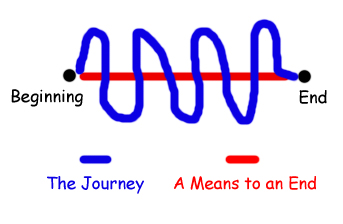
The Market is a Means, not an End


Even the greatest proponents of laissez faire economics would admit that the market is not an end, but rather a means.  Larry Kudlow's creed is "Free market capitalism is the best path to prosperity."  That's right, its a path!  So why have so many business leaders and financial media pundits attempted to create a belief that the market is something that must be preserved and nurtured?  Isn't the market merely the collection of opinions expressed by dollars?  If the government or the people choose to encumber, regulate or manage those opinions expressed in dollars is that not just another manifestation of the "market?"  Is not the choice to not encumber, regulate or manage those opinions expressed in dollars also a factor of the "market? Most importantly, does it even matter?

Welcome to the deepest depths of this blog to date.  A philosophical puzzle that seeks no solution other than to paint shades of gray that shall make the reader come to their own conclusion based in logic rather than borrowed rhetoric or sloppy undeveloped thoughts, if one hasn't done so to date.  In fact, if the reader is not prepared for this type of philosophical self-reflection, come back next week and I will be back to suggesting solutions to the chasms in our economy, politics and country.

The point:  The goal of any socioeconomic system, culture, government or process in general is a greater standard of living for its people.  In defining the concept of standard of living, one must not only count wealth, but the purpose that wealth serves.  In other words, standard of living is a mark on a barometer  which measures the ability of a population to live.  It begins on the low end with "attain what one needs" and culminates with "attain whatever one desires."  It is nonsensical, or rather simply incomplete, to state a standard of living is money or tangible goods because the logical question is money and tangible goods for what purpose?  It's money to be free, or it's money to exert power over people, or money to live a life of leisure, or money to create security, or whatever.  Its not the money, its the end that the money makes reality that is the intention or goal.

So, if money and tangible items are a vehicle, and the market is a vehicle to create or multiply that money, and the end is to maximize the standard of living of living of a population- the issue is thus centered around how we as citizens of a society get to that end in the most efficient and/or equitable manner.  Remember, this particular article does not have the purpose of solving what is the best path to reach our end, it's merely to silence the annoying undeveloped statements of many who believe that the market is the end.  

Two days ago I was reading an article from a brilliant financial planner who stated that the market shall prevail in destroying much of the Nation's wealth despite any efforts of the population to stave off such a doom through stimulus, the federal reserve and the treasury.  The purpose of this article is not to argue whether or not the stimulus plan shall work, or whether Keynesian economic tools are effective, its merely to disprove the careless careless conclusion of this highly respected professional.  If the market is not creating a greater standard of living, it is failing and not prevailing.  Remember, the market having its way is nothing more than a runaway car as the intended destination is an aggregate maximized standard of living (not to be confused with an equal standard of living for all which is the goal of communism).

Now I know many readers would argue that in the long run the market is the best path to the end of standard of living, but I argue today that the long run is a summation of successes and failures.  All I ask is that people admit that when the market is destroying wealth and creating a worse standard of living for those exposed to it, that it is in fact failing them at that time.  After all, we should not treat the market as a deity.  It is not always positive, it is not always correct.  It has always worked itself out of its troubles, but it is neither a good or evil, it just is.  In fact, the culmination of people's opinions as valued in money may not even be measurable as a provable existence.  The idea of "the market" might simply be an expression of the common statement "it is what it is."

Whether it's the best we've got or the best we can ever get, the market and the management of its consequences should never be without criticism or reflection.  The market deserves no sanctity or elevated stature.  Its merely a mechanism.  Sometimes it works to its intended purpose, sometimes not.  It is a very strong mechanism; but, nonetheless one for the purpose of making our collective lives better.   From here, the conclusion is yours to write.