Showing posts with label stock market. Show all posts

Thursday, February 19, 2009

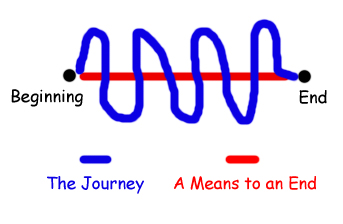
The Market is a Means, not an End


Even the greatest proponents of laissez faire economics would admit that the market is not an end, but rather a means.  Larry Kudlow's creed is "Free market capitalism is the best path to prosperity."  That's right, its a path!  So why have so many business leaders and financial media pundits attempted to create a belief that the market is something that must be preserved and nurtured?  Isn't the market merely the collection of opinions expressed by dollars?  If the government or the people choose to encumber, regulate or manage those opinions expressed in dollars is that not just another manifestation of the "market?"  Is not the choice to not encumber, regulate or manage those opinions expressed in dollars also a factor of the "market? Most importantly, does it even matter?

Welcome to the deepest depths of this blog to date.  A philosophical puzzle that seeks no solution other than to paint shades of gray that shall make the reader come to their own conclusion based in logic rather than borrowed rhetoric or sloppy undeveloped thoughts, if one hasn't done so to date.  In fact, if the reader is not prepared for this type of philosophical self-reflection, come back next week and I will be back to suggesting solutions to the chasms in our economy, politics and country.

The point:  The goal of any socioeconomic system, culture, government or process in general is a greater standard of living for its people.  In defining the concept of standard of living, one must not only count wealth, but the purpose that wealth serves.  In other words, standard of living is a mark on a barometer  which measures the ability of a population to live.  It begins on the low end with "attain what one needs" and culminates with "attain whatever one desires."  It is nonsensical, or rather simply incomplete, to state a standard of living is money or tangible goods because the logical question is money and tangible goods for what purpose?  It's money to be free, or it's money to exert power over people, or money to live a life of leisure, or money to create security, or whatever.  Its not the money, its the end that the money makes reality that is the intention or goal.

So, if money and tangible items are a vehicle, and the market is a vehicle to create or multiply that money, and the end is to maximize the standard of living of living of a population- the issue is thus centered around how we as citizens of a society get to that end in the most efficient and/or equitable manner.  Remember, this particular article does not have the purpose of solving what is the best path to reach our end, it's merely to silence the annoying undeveloped statements of many who believe that the market is the end.  

Two days ago I was reading an article from a brilliant financial planner who stated that the market shall prevail in destroying much of the Nation's wealth despite any efforts of the population to stave off such a doom through stimulus, the federal reserve and the treasury.  The purpose of this article is not to argue whether or not the stimulus plan shall work, or whether Keynesian economic tools are effective, its merely to disprove the careless careless conclusion of this highly respected professional.  If the market is not creating a greater standard of living, it is failing and not prevailing.  Remember, the market having its way is nothing more than a runaway car as the intended destination is an aggregate maximized standard of living (not to be confused with an equal standard of living for all which is the goal of communism).

Now I know many readers would argue that in the long run the market is the best path to the end of standard of living, but I argue today that the long run is a summation of successes and failures.  All I ask is that people admit that when the market is destroying wealth and creating a worse standard of living for those exposed to it, that it is in fact failing them at that time.  After all, we should not treat the market as a deity.  It is not always positive, it is not always correct.  It has always worked itself out of its troubles, but it is neither a good or evil, it just is.  In fact, the culmination of people's opinions as valued in money may not even be measurable as a provable existence.  The idea of "the market" might simply be an expression of the common statement "it is what it is."

Whether it's the best we've got or the best we can ever get, the market and the management of its consequences should never be without criticism or reflection.  The market deserves no sanctity or elevated stature.  Its merely a mechanism.  Sometimes it works to its intended purpose, sometimes not.  It is a very strong mechanism; but, nonetheless one for the purpose of making our collective lives better.   From here, the conclusion is yours to write.

Thursday, January 22, 2009

The stock market: Is it a trailing or leading indicator


Does the stock market predict things to come, or does it reflect things passed? Believe it or not, the answer is quite intuitive and simple. Stranger than that is that many financial planners, economists business leaders and stock analysts have it wrong. The answer is unavoidably that the stock market trails movement in the real economy.

How can this be? Everyday on the financial news it is taken as a given that the stock market is a predictor of the future of the economy and quite efficient in doing it. Such sources also tell us that the stock market is an efficient mechanism that reflects the true price of an asset or company based on the compilation of large sampling of peoples' opinions. Books such as The Wisdom of Crowds, by James Suroweiki, further state that large sample sizes of random guesses tend to better predict an unknown (such as an asset value or stock price) than an individual. Further, this school of thought has run a number of controlled tests that proved that a large sample size of random guesses is better at predicting an unknown than a small number of better equipped individuals (smarter or more experienced) who are collaborating to formulate a guess.

The fundamental premise is that information provided must be equal to all guessing.


It is a very small jump from this conclusion to state that markets best reflect the true value of an asset or company so long as information is freely available. People from this school of thought are most commonly referred to as Efficient Market Theorists (EMTs). Business programs predominately teach this method of market valuation to MBA students and the majority of players on the scene believe this to be true. So, if assuming EMT is correct, how can the market be a trailing indicator? Wouldn't it be a good predictor of the future?


Unfortunately not. The precipitous decline in the stock market in the fall of 2008 was clearly a reflection of the steady decline in the American economy beginning in the middle of 2007. The economy was sputtering in 2007, and financial analysts told the public nothing was wrong, and that if one separated the durables, autos, homes and mortgage business from the remainder of the economy everything was just fine. That was an incredible statement, and a terrible misrepresentation. It is common knowledge that durables, autos, and homes are the first indicator of a recession and as soon as they show declines, the entire economy shall follow. In fact, Alan Greenspan's company, prior to him becoming Federal Reserve Chairman, used to predict business cycles by simply tracking durables and automobile sales. That said, financial analysts, newscasters and government officials insisted that this was a "new" economy and such variables were no longer dispositive. Wrong. Funny how Greenspan, in his eighties nonetheless, predicted the recession within weeks.


The stock market continued on its upward trend throughout 2007 despite all prudent economists understanding a full blown recession would hit before the end of the year. Why was the market not reacting? The answer: denial and data.


1. Data

The first reason why the stock market is unable to predict future movements in the economy is that the prices are set by the purchase and sale of equities by analysts who base their decisions on data now known. The imperative here is that the prices are dependant on the reporting by companies of events that have already happened. Earnings, estimates and strategies released by companies are always released well after they have occurred. In other words, analysts, financial reporters, and traders receive data that has been processed by Board of Directors and executives for days, weeks and months. Therefore, it is an incontrovertible fact that stock prices trail real economic events. This reality is multiplied tenfold when the economy is recessing as companies will use deferrals and reserved profits from past expansions to buffer evidence of a slowdown in their business. The result, analysts and buyers are even further behind the curve of a bear market.

It is important to note that it isn't only business data that is slow to market, government data is painfully slow to market. One great example is jobless claims. First, one must admit that reducing capacity is one of the last cuts a business is to make. In most cases, businesses will begin cutting all areas that don't directly affect their ability to produce. As a result, necessary job cuts often come well too late in the business cycle as businesses must be sure demand won't rebound before diminishing capacity in the work force. The point is that the real economy has shifted and the financial news channels, traders, analysts and economists cannot see the shift. In other words, the government reports, which traders rely on to trade and invariably derive some picture of the future are more analogous to the wake than the boat.

In addition to equity reports and government reports lagging economic realities, commodity reports must be the least reliable of the bunch. A great example is OPEC. Cheating, overproducing and general market manipulation have created an environment where analysts and traders no longer trust forward announcements of OPEC. Analysts don't believe OPEC when they declare they will produce more oil to keep prices tolerable and they don't believe OPEC can restrain from producing at lower prices despite promises to do so to increase prices.
The net result is analysts, financial networks, and traders basing future decisions on inventory reports from the past. Worse yet, these reports are incapable of determining whether reserved supplies increased or decreased due to demand or supply. Regardless, players in this game determine how to bet based changes in the past.

In all fairness, I must state that many efficient market theorists would argue that traders, analysts and economists don't believe they are guessing at a future valuation of a company, but rather using the data to generate a prediction as to the present value of the company in real time. If that is the case, then the stock market is neither a trailing indicator or a leading indicator of the economy, but rather a barometer of the economy in that exact moment. That said, the general tendency of the market to wait for trends to emerge and the complimentary tendency to hesitate before declaring a change of trend leads to a conclusion that the stock market isn't even an efficient indicator of the current market.


2. Denial

The second reason why the stock market and asset prices always lag reality is because of momentum, or as I like to call it denial. Humans are creatures of habit. When things have been trending downward, people cannot imagine what it was like when things were growing. Vice-versa, when things are growing people cannot imagine a reversal as the common tendency is to believe "things are fundamentally different this time(commodity bubble, tech bubble, housing bubble, and soon to be the end of health care bubble)." As a result, analysts, brokers, traders and economists wait for a trend to emerge before declaring it safe to change direction.

That's right! Not only are these market participants basing decisions off of old data, once they see data signaling a change, such data is earmarked as an "aberration" until it duplicates itself. In the clearest sense people literally wait to buy once the real economics have turned more favorable and usually do so six to eight months after the company has realized the change in business.

The funniest part is that once the decision to purchase or sell is made, the real run of expansion or recession is well underway indicating that the reversal of that trend is closer than the market participants realize. As the price moves because of these transactions, it attracts more transactions in the same direction which most closely can be analogized to a stampede. This stampede always overshoots its target as the participants are watching old data and waiting in denial for trends. This creates the wild inefficiencies of markets in the short run, and also illuminates why 95% of the investing public ends up wrong all the time.

While I'm certain it is human nature to buy high and sell low because its the popular thing to do, its comical how we fear to act when the opportunity costs are low (prices are low because the majority are predicting further wealth destruction) and are so brave to act when the opposite is true. When the trend of past data is upward, indicative of a bull market, we as investors love to run directly off a cliff. Reminiscent of the old roadrunner cartoon, standing on nothing but air and filled with a false confidence by the reported data we believe to be a reliable prophecy of the future, there is no where to go but down.